About this ebook
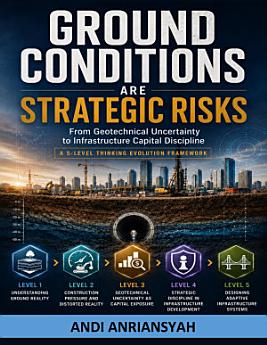
Ground Conditions Are Strategic Risks presents a new way of thinking about subsurface uncertainty—not as a narrow technical issue, but as a strategic force that can reshape the economics and delivery of infrastructure projects. From foundations, excavations, tunneling, and groundwater to contingency, organizational behavior, and long-term asset performance, the book follows the pathway by which incomplete knowledge of ground conditions becomes redesign, delay, claims, cost escalation, maintenance burden, and irreversible capital exposure.
At the center of the book is the Strategic Ground-Risk Framework, an integrated architecture connecting ground reality, geotechnical uncertainty, operational translation, infrastructure sequencing, capital exposure, organizational learning, adaptive construction, and long-term infrastructure resilience. The framework provides infrastructure leaders and technical professionals with a practical language for understanding not only what can happen in the ground, but also when uncertainty should change a decision, how much commitment is justified, and how organizations can preserve flexibility as new evidence emerges.
The book moves beyond conventional risk registers and percentage contingencies to examine the deeper organizational mechanisms that amplify geotechnical risk: schedule pressure, premature commitment, deterministic planning, KPI distortion, governance failure, operational momentum, and the normalization of uncertainty. It then develops an adaptive approach in which investigation, monitoring, sequencing, decision gates, and construction responses work as an integrated learning system.
Written for professionals working at the intersection of engineering and infrastructure delivery, this book is intended for project directors, construction managers, geotechnical engineers, engineering geologists, tunneling professionals, infrastructure owners, risk specialists, project executives, consultants, and capital decision-makers.
The central message is simple:
The ground cannot be made certain. Infrastructure decisions can be made more disciplined.
Discover more
Ratings and reviews

- Flag inappropriate

- Flag inappropriate

- Flag inappropriate
About the author
The Author is a geologist and petrophysicist with more than 17 years of experience spanning the oil and gas, mining, exploration, and infrastructure sectors. His professional background includes subsurface evaluation, geological interpretation, geological quality control, ground-condition assessment, and technical support for multidisciplinary project environments. His infrastructure experience includes technical involvement in major hydroelectric development, including dam foundation works, underground and open excavations, and slope stability assessment. His work has consistently involved translating geological and subsurface understanding into practical considerations for project planning, execution, quality control, and risk management.
His professional perspective has developed at the intersection of subsurface science, engineering judgment, construction execution, and project decision-making. Across different industries and project environments, he has focused on how uncertainty in the subsurface interacts with schedule pressure, operational priorities, technical governance, and capital decisions. Ground Conditions Are Strategic Risks brings these experiences together into the Strategic Ground-Risk Framework, with the aim of giving infrastructure professionals a more integrated language for managing ground uncertainty—from initial investigation and construction sequencing to capital exposure, organizational learning, and long-term infrastructure resilience.