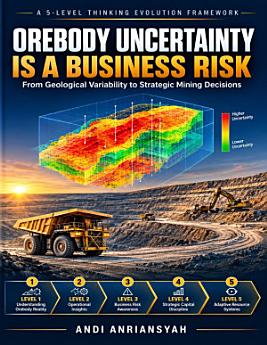
About this ebook
It fails when organizations make irreversible decisions as if the orebody were already understood.
Every geological model is an approximation. Every mine plan is built on assumptions. Every production forecast carries uncertainty forward into infrastructure, capital allocation, operating performance, and ultimately enterprise value. Yet geological uncertainty is still too often treated as a technical issue owned primarily by geology rather than as a business risk shared across the entire mining organization.
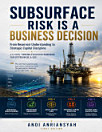
Orebody Uncertainty Is a Business Risk presents a different way to think about mining under uncertainty.
The book introduces the Orebody Strategic Intelligence Framework (OSIF), an integrated architecture that traces geological variability from the physical characteristics of the orebody through operational behavior, mine sequencing, reserve confidence, capital exposure, governance, organizational learning, and adaptive resource design. The framework is developed progressively through five levels of thinking and eight interconnected system components.
Across 25 chapters, the book examines how uncertainty becomes amplified through:
geological interpretation and estimation
grade variability and geometallurgical uncertainty
dilution and ore loss
mine sequencing and production forecasting
reserve confidence and reporting
processing variability
infrastructure commitments
capital escalation
organizational behavior
governance and decision-making
strategic pacing
optionality and adaptive mine design
organizational learning and resilience
The central argument is simple but consequential:
The orebody is not the model. The model is our current hypothesis about the orebody.
The strategic question is therefore not how to eliminate uncertainty. That is impossible. The question is how to design mining organizations that make better decisions because they understand uncertainty, preserve options when uncertainty matters, commit capital progressively, and learn faster as geological reality is revealed.
This is not a conventional geology textbook, mine-planning manual, or mining finance book. It is a cross-disciplinary decision framework for mining leaders, technical professionals, planners, capital allocators, and organizations responsible for turning geological knowledge into long-term value.
Discover more
Ratings and reviews

- Flag inappropriate

- Flag inappropriate

- Flag inappropriate
About the author
The author writes at the intersection of geological uncertainty, mining operations, capital allocation, strategic decision-making, and organizational design. The work behind Orebody Uncertainty Is a Business Risk reflects a systems perspective: geological knowledge is treated not as an isolated technical output, but as intelligence that must influence mine planning, operational decisions, capital commitments, governance, and long-term resource strategy. The book's central framework, the Orebody Strategic Intelligence Framework (OSIF), was developed to connect these domains into a coherent architecture for mining organizations operating under irreducible geological uncertainty.
Rather than presenting uncertainty as a problem that can simply be solved through more data or better models, the author focuses on the organizational capabilities required to make better decisions while uncertainty remains. This includes uncertainty literacy, optionality awareness, learning velocity, behavioral discipline, strategic pacing, systemic thinking, and the ability to connect geological intelligence directly to capital and strategic decisions. Through this perspective, the author's work aims to contribute to a more adaptive model of mining leadership—one in which organizations build not only better mines, but better systems for learning, deciding, and creating value under geological uncertainty.