About this ebook
Every year, construction projects lose time, money, and productivity—not because of bad engineering, but because of a gap between design intent and execution reality.
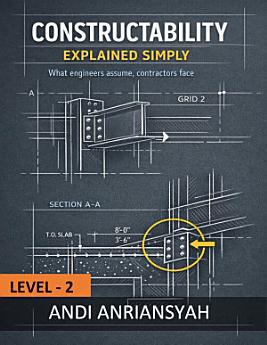
Constructability Explained Simply is a practical, field-grounded guide that reveals where that gap comes from, how it manifests, and—most importantly—how to prevent it.
Written from years of experience at the interface between engineering design and construction execution, this book translates real site constraints into actionable insights for design engineers, project engineers, and construction professionals.
Inside this book, you will learn:
- Why “correct” designs still create costly problems on site
- How access, sequence, tolerance, and logistics drive hidden project risk
- Where constructability gaps originate in the design process
- How small design decisions create large downstream cost impacts
- What questions to ask before issuing drawings for construction
Each chapter focuses on a specific, recurring constructability issue—supported by real-world patterns, anonymized case studies, and practical reflections that can be applied immediately.
This is not a textbook.
This is not a theory-heavy manual.
This is a translation—between the drawing and the field.
If you produce drawings, review designs, estimate projects, or build what others design, this book will change how you see every project.
Because the drawing is not the building.
It is an instruction for making the building.
Write better instructions.
Discover more
About the author
Andi is a senior technical professional with 17+ years of experience across oil & gas, mining, and infrastructure projects, working at the boundary between subsurface evaluation and project execution. His career has been built at the boundary between design engineering and site execution — contributing technical input to engineering and construction coordination for construction, supporting and reviewing site work against design intent, and investigating the gap between what drawings assume and what sites face.
Constructability Explained Simply is written from a conviction that has grown over decades of fieldwork: that the gap between design intent and construction reality is not a natural law. It is a consequence of professional context separation — of engineers who design without field experience, and of field professionals who manage problems that better design would have prevented. That gap is closeable. Not perfectly and not all at once. But practically, consistently, and significantly — if the people who draw the drawings ask, before they issue them, how they will be built.