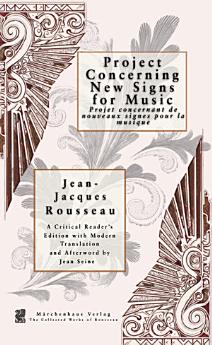
Project Concerning New Signs for Music: A New Reader's Edition

· The Collected Works of Jean Jacques Rousseau Book 12 · Märchenhaus Verlag
Ebook
71
Pages
Eligible
24% price drop on Oct 28

About this ebook

Rousseau's first venture into public debate is a technical memorandum on music notation, drafted in Paris while he sought work as a copyist. He proposes a numeric staff that would let amateurs read melody at a glance, a direct challenge to the ornate symbols used at the royal opera. The plan never reached print, yet in manuscript it circulated among musicians and caught the eye of Rameau, who dismissed it as naïve. That clash marked the start of Rousseau's feud with professional theorists who prized structure over feeling. In spirit he moves away from Voltaire's praise of French brilliance and closer to Hobbes's distrust of intellectual monopoly, minus Hobbes's appetite for sovereign policing. Diderot, busy launching the Encyclopédie, hoped new knowledge would free the public; Rousseau worries it may do the opposite if locked behind difficult codes. Jean Jacques Rousseau's 1742 Projet concernant de nouveaux signes pour la musique (Project Concerning New Signs for Music) proposed a radical simplification of musical notation. Rousseau envisaged writing music on a single line, using the numbers 1, 7 in place of the solfège syllables (Do=1, Ré=2, Mi=3, etc.) and simply changing the clef to indicate key shifts. He openly criticized the traditional five line staff as "imperfect" and overly cumbersome to learn. In his treatise he explains that his system pursues "two main objectives": first, to notate music and all its difficulties in a much "simpler, more convenient" fashion and in a smaller space; second, to make music "as easy to learn as it has been difficult up to now" by reducing the number of symbols without losing any expressive power.

In other words, he would abbreviate musical rules so thoroughly that theory became almost a game and performance would depend only on natural habit, not on intellectual struggle. Practically speaking Rousseau claimed this numeric notation would drastically cut learning time (he claimed students would master the new system "in two or three times less time than by the ordinary method") and even allow lay amateurs to sight read tunes immediately. More philosophically, the scheme embodied Enlightenment ideals of clarity and accessibility: as one commentator notes, Rousseau saw his reform as a complete reworking of music's "language" with the goal of making it "more human, less professional"This professional translation delivers scholarly depth with supporting materials. The edition of Project Concerning New Signs for Music supplements the text with an afterword tracing Rousseau's intellectual relationship with Diderot, Voltaire and his reception by Nietzsche, revealing the detailed dialogue between the period's most influential minds. The supporting chronology for Project Concerning New Signs for Music connects the major events of Rousseau's life with world events, a glossary of Enlightenment terminology frames Rousseau's debates in the intellectual milieu of his day, and a detailed index provides an guide to his complete writings.

The Académie's response was courteous but finally unsupportive. An official report praised Rousseau's manuscript as "made with art and stated with great clarity," but declined to endorse it. The evaluators argued that the idea was neither new nor sufficiently useful: a century earlier a Cordelier monk (Père Souhaitty) had already proposed the same numeric scheme, and the Academy required that any proposal be both novel and advantageous. In short, Rousseau's numeric notation was set aside. This setback quickly redirected his career toward the broader Enlightenment scene: after 1742 he turned to writing and soon joined Diderot's Encyclopédie project (in fact, by 1744 he "began to write work in the Encyclopédie"). In the wider setting of 18th century musical theory, which was by now dominated by Rameau's mathematically oriented harmony, Rousseau's emphasis on simplicity and performer immediacy stood out. He would later clash openly with Rameau and others, insisting that music's value lies in melody and human emotion rather than abstract rules. In retrospect, the Projet des nouveaux signes shows Rousseau's early Enlightenment agenda: a rational reform intended to democratize the art of music. By seeking to make notation as intuitive as possible, he was applying the same ideals of reason, clarity and education that would shape his later works. In Rousseau's own terms, he in practice treated musical notation itself as a human "language" to be simplified for the benefit of all.

Rousseau's first venture into public debate is a technical memorandum on music notation, drafted in Paris while he sought work as a copyist. He proposes a numeric staff that would let amateurs read melody at a glance, a direct challenge to the ornate symbols used at the royal opera. The plan neve...

Discover more

About the author

Jean Jacques Rousseau (1712 to 1778) was a Genevan writer, philosopher, and composer. He wrote on political authority, inequality, education, language, music, religion, and autobiography; his books include Discourse on Inequality, The Social Contract, Emile, Julie, and the Confessions.

Rate this ebook

Tell us what you think.

Reading information

Smartphones and tablets
Install the Google Play Books app for Android and iPad/iPhone. It syncs automatically with your account and allows you to read online or offline wherever you are.
Laptops and computers
You can listen to audiobooks purchased on Google Play using your computer's web browser.
eReaders and other devices
To read on e-ink devices like Kobo eReaders, you'll need to download a file and transfer it to your device. Follow the detailed Help Center instructions to transfer the files to supported eReaders.