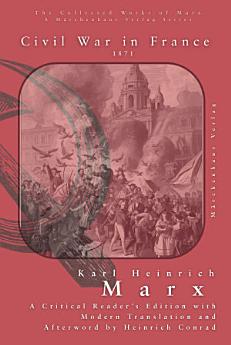
Civil War in France: A New Reader's Edition
About this ebook
The text is notable for its austere and urgent tone, eschewing rhetorical flourish for structural analysis, though metaphysical echoes persist in its rendering of the Commune as both the negation of the old world and the tentative affirmation of a new one. In tracing the Commune's abolition of the standing army, its substitution of recallable delegates for bureaucrats, and its attempts to reorganize labor and education, Marx constructs an image of revolutionary time in which the present becomes thick with unrealized potential. Though the pamphlet functions as political justification, it is also a philosophical intervention: history appears not as linear progress but as an opening brief, tragic, and luminous where the social relations underlying state power are exposed and reversed.
Alongside Civil War in France, the volume provides an afterword tracing Marx's intellectual relationships with revolutionary thinkers and philosophers (including Hegel, Feuerbach, Engels, and Ricardo), containing research into his ideological development and economic metaphysical theories, a complete timeline of his life and works, a glossary of Marxist terminology, and a detailed index of all of Marx's writings. The translation of Civil War in France renders Marx's dense dialectical prose in modern English while preserving its force and precision. The supporting material situates Civil War in France within Marx's wider intellectual project and the political, economic, religious, and philosophical debates surrounding it.