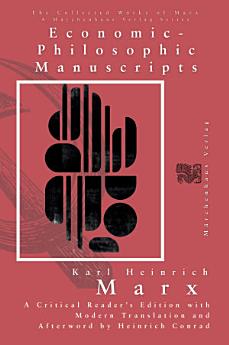
Economic Philosophic Manuscripts: A New Reader's Edition

· The Collected Works of Marx Book 1 · Märchen Press
1 review
Ebook
199
Pages
Eligible

About this ebook

Written during a formative period in Paris in 1844, the Economic Philosophic Manuscripts (also known as Paris Manuscripts or Manuscripts of 1844) were left unpublished during Marx's lifetime and only became accessible in the 1930s after being discovered among his papers. These pages, unfinished and repetitive, capture a moment of theoretical transition as Marx grapples with the works of Feuerbach, Hegel, and classical political economy in an effort to synthesize materialist anthropology with a critique of alienated labor. Despite their fragmented state, they mark one of the first systematic efforts to conceptualize estrangement within capitalist production, where man becomes estranged from the product of his labor, but from his species being and from other men.

Composed between April and August of that year, these manuscripts sketch a humanist critique of private property, money, and political economy through the viewpoint of speculative philosophy and are saturated with allusions to Hegel's Phenomenology of Spirit, Adam Smith's economic theory, and Feuerbach's human centered theology. Although never completed, they state early formulations of alienation, need, labor, and species life that would reappear in transmuted forms in his later economic works. The third manuscript includes a prefatory section that retroactively is a key to the other two, offering a theoretical justification for the method and categories being deployed. Their disordered form belies the underlying coherence of an author attempting to locate the conditions under which man could be restored to himself through the transformation of the economic base.

For contextual study, Economic Philosophic Manuscripts is accompanied by an afterword tracing Marx's intellectual relationships with revolutionary thinkers and philosophers (including Hegel, Feuerbach, Engels, and Ricardo), containing research into his ideological development and economic metaphysical theories, a complete timeline of his life and works, a glossary of Marxist terminology, and a detailed index of all of Marx's writings. In Economic Philosophic Manuscripts, Marx's dialectical prose is presented in contemporary English with attention to the argument's original force and precision. The supporting material situates Economic Philosophic Manuscripts within Marx's wider intellectual project and the political, economic, religious, and philosophical debates surrounding it.
Written during a formative period in Paris in 1844, the Economic Philosophic Manuscripts (also known as Paris Manuscripts or Manuscripts of 1844) were left unpublished during Marx's lifetime and only became accessible in the 1930s after being discovered among his papers. These pages, unfinished a...

Discover more

Ratings and reviews

1 review

About the author

Karl Marx (1818 to 1883) was a German philosopher, economist and revolutionary whose ideas have had a deep influence on political theory, economics and social science. Along with Friedrich Engels, Marx developed the theory of historical materialism, arguing that economic structures fundamentally shape social development. His seminal works, The Communist Manifesto and Das Kapital, criticise the capitalist system, arguing that it leads to class struggle and the exploitation of the working class. Marx envisioned a society in which class distinctions would dissolve, culminating in a classless, stateless society. His theories laid the foundations for several socialist and communist movements, influencing world politics and inspiring revolutions. Although controversial, Marx's analysis of capitalism and advocacy of social justice continue to be studied and debated, making him one of the most influential thinkers in modern history.
Karl Marx (1818 to 1883) was a German philosopher, economist and revolutionary whose ideas have had a deep influence on political theory, economics and social science. Along with Friedrich Engels, Marx developed the theory of historical materialism, arguing that economic structures fundamentally ...

Rate this ebook

Tell us what you think.

Reading information

Smartphones and tablets
Install the Google Play Books app for Android and iPad/iPhone. It syncs automatically with your account and allows you to read online or offline wherever you are.
Laptops and computers
You can listen to audiobooks purchased on Google Play using your computer's web browser.
eReaders and other devices
To read on e-ink devices like Kobo eReaders, you'll need to download a file and transfer it to your device. Follow the detailed Help Center instructions to transfer the files to supported eReaders.

Continue the series

More by Karl Marx

Similar ebooks