About this ebook
Rather than addressing philosophical errors alone, Marx focuses on the economic categories themselves value, exchange, division of labor arguing that Proudhon abstracts them from their historical development and disguises the relations of exploitation at their core. The text elaborates Marx's emerging labor theory of value, defends the necessity of revolutionary upheaval over reformist utopianism, and begins to frame class struggle as the motor of history. Though the German translation was not published until 1884 in Stuttgart, the original version marks a turning point where Marx establishes a clear theoretical distance from earlier socialist thinkers, refusing moral appeals or idealist schemas in favor of a method grounded in material relations and political confrontation.
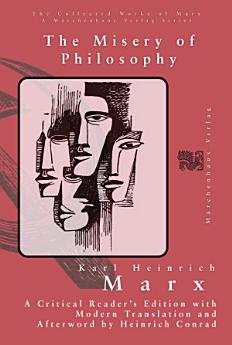
For The Misery of Philosophy, to provide historical and intellectual context, the edition includes an afterword tracing Marx's intellectual relationships with revolutionary thinkers and philosophers (including Hegel, Feuerbach, Engels, and Ricardo), containing research into his ideological development and economic metaphysical theories, a complete timeline of his life and works, a glossary of Marxist terminology, and a detailed index of all of Marx's writings. The translation of The Misery of Philosophy renders Marx's dense dialectical prose in modern English while preserving its force and precision. Together, the translation and supporting apparatus place The Misery of Philosophy within Marx's intellectual development and its political, religious, economic, and philosophical reception.