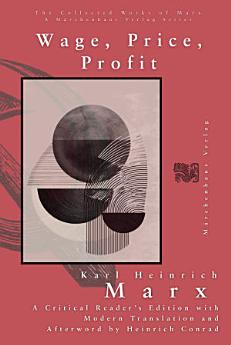
Wage, Price, Profit: A New Reader's Edition
About this ebook
Though lacking the formal abstraction of Das Kapital, the work moves with similar conceptual rhythms, in which surface appearances prices, wages, profits conceal deeper relations governed by labor time and the appropriation of surplus. Marx's insistence that capital is not a thing but a social relation finds a clear expression here, and the didactic tone does not dilute the metaphysical undertow: value remains an abstraction animated by labor, and the capitalist system a self expanding totality whose logic appears autonomous. Framed as a practical rebuttal, the text nonetheless retains the structural rigor of dialectical exposition, offering a compressed glimpse into the machinery of accumulation and the illusion of "fair exchange" under wage labor. This edition supplements the primary text with reference materials that contextualize Marx's philosophical lineage and clarify his terminology, making visible the intellectual scaffolding behind its economic clarity.
For Wage, Price, Profit, to provide historical and intellectual context, the edition includes an afterword tracing Marx's intellectual relationships with revolutionary thinkers and philosophers (including Hegel, Feuerbach, Engels, and Ricardo), containing research into his ideological development and economic metaphysical theories, a complete timeline of his life and works, a glossary of Marxist terminology, and a detailed index of all of Marx's writings. The translation of Wage, Price, Profit renders Marx's dense dialectical prose in modern English while preserving its force and precision. Together, the translation and supporting apparatus place Wage, Price, Profit within Marx's intellectual development and its political, religious, economic, and philosophical reception.