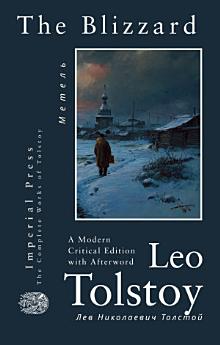
The Blizzard
About this ebook
"The Blizzard," or "Метель" in Russian, was published in 1856 in the journal "Современник" (Sovremennik). This short story is narrated by an author traveling in a sleigh with a coachman and a young boy, Alyoshka, after departing a station near Novocherkassk in the evening. As a blizzard intensifies, the travelers lose their way, and the sleigh ride evolves into an existential experience. The narrator drifts into a semi conscious state, experiencing a series of vivid dreams and fragmented memories that intertwine with the harsh realities of the storm.
The story's focus on the internal experience of disorientation and the blurring of reality and dream provides a persuasive psychological study. Tolstoy employs the relentless, monotonous nature of the blizzard as a symbolic backdrop against which the protagonist's subconscious unfolds, revealing a rich mixture of past encounters and internal reflections. "The Blizzard," though a concise work, shows Tolstoy's early mastery of atmospheric description and his burgeoning interest in the difficulties of the human mind. It is an early example of his ability to imbue seemingly simple events with deep existential resonance, a characteristic that would define his later, more celebrated works.
This critical reader's edition presents a modern translation of the original manuscript, crafted for the modern reader with clean, modern language and simplified sentence structures that clarify his difficult Russian phrasing and specific antiquated references. Supplementary material enriches the text with autobiographical, historical, and linguistic setting, including an afterword by the translator on Tolstoy's personal history, impact, and intellectual legacy, an index of the philosophical concepts he employs, giving attention to Existentialism and influence by Schopenhauer, a complete chronological list of his published writings, and a detailed timeline of his life, showing the personal relationships that shaped his philosophy.