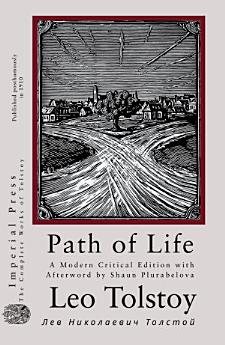
Path of Life
About this ebook
"Path of Life," or "Путь жизни" in Russian, was compiled by Leo Tolstoy between 1903 and 1910, and published in 1910. This book is the culmination of Tolstoy's life's work, serving as his final philosophical and spiritual testament. It brings together his own thoughts and selected quotations from several world philosophers and sages, including Kant, Lessing, Marcus Aurelius, Rousseau, Schopenhauer, Ramakrishna, Grigory Skovoroda, and John Chrysostom.
The composition is a collection of reflections on basic human concerns such as death and immortality, the nature of true religion and faith, the meaning of love, and the purpose of life. It was preceded by other similar compilations like "Thoughts of Wise People," "Circle of Reading," and "For Every Day". "Path of Life" functions as Tolstoy's spiritual instruction, a guide for readers seeking to understand his mature worldview and his ultimate conclusions on how one should live.
This critical reader's edition presents a modern translation of the original manuscript, crafted for the modern reader with clean, modern language and simplified sentence structures that clarify his difficult Russian phrasing and specific antiquated references. Supplementary material enriches the text with autobiographical, historical, and linguistic setting, including an afterword by the translator on Tolstoy's personal history, impact, and intellectual legacy, an index of the philosophical concepts he employs, giving attention to Existentialism and influence by Schopenhauer, a complete chronological list of his published writings, and a detailed timeline of his life, showing the personal relationships that shaped his philosophy.