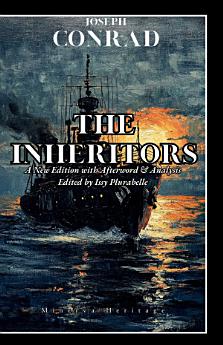
The Inheritors: A New Reader's Edition
About this ebook
Joseph Conrad and Ford Madox Ford's collaborative novel The Inheritors (1901) is a political allegory blending satire and speculative fiction. Historically overshadowed by Conrad's great solo works (Heart of Darkness, Nostromo etc), it remains a curious artifact of early modernist experimentation. It follows an unnamed protagonist, an idealistic young writer, entangled with a mysterious woman named Eleanor, a member of the "Dimensionists", cold, amoral beings from a future fourth dimension infiltrating modern society. The Dimensionists manipulate political and financial systems to supplant the old order, symbolizing the rise of corporate imperialism and bureaucratic exploitation. The protagonist's gradual complicity in their schemes critiques the erosion of individual morality under modernity's impersonal forces. Stylistically, the novel experiments with irony and fragmented narration, though its abstract allegory and tonal unevenness (attributed to the authors' diverging visions) led to mixed reception. Critics note its prescient themes of media manipulation, capitalist dehumanization, and the displacement of humanistic standards by soulless efficiency, framed through a viewpoint of fin de siècle anxiety.
Here, Conrad uses a phrase from G.K. Chesterton, who was a modern living in London at the same time. In his 1914 book Heretics, Chesterton devoted a chapter to Conrad, acknowledging his literary skill but expressing deep reservations about Conrad's worldview. Chesterton believed that Conrad's fiction was dominated by a kind of cosmic pessimism and moral ambiguity that he, as a theologically inclined writer, found an accurate representation of the Nihilism of the Modernism he raged against. Chesterton admired the beauty of Conrad's prose but saw in it a disturbing absence of moral clarity or affirmation, especially compared to his own more metaphysically anchored view of the universe. Both authors criticized Colonialism and heavily condemned Social Darwinism.
He wrote:
"Mr. Conrad has a dark spirituality: it is a nihilism that gropes."
This modern edition of Conrad's classic novel includes a fresh Afterword, extensive reference materials including a timeline of Conrad's life and works, character glossary and group discussion questions on this literary classic. For this edition of The Inheritors, archaic terminology has been lightly revised to improve readability.
The novel operates as a feverish parable of displacement, where the "inheritors" are not a new generation but alien entities embodying the mechanistic logic of modernity. Eleanor, with her glacial charisma, seduces the protagonist not through passion but by appealing to his intellectual vanity and latent cynicism. Her Dimensionists, devoid of empathy, driven by pure pragmatism, mirror the emerging power structures of the 20th century: corporate monopolies, political cabals, and media spectacles that reduce human agency to a commodity. The protagonist's moral drift shows Conrad's skepticism toward progress stories; his collaboration with Ford infuses the text with a sardonic edge, contrasting the narrator's romantic naivete with the inheritors' clinical ruthlessness. The abstract plot, often criticized as opaque, is a metaphor for the invisibility of systemic corruption, how ideals are hollowed out not by grand villains but by incremental compromise. While uneven, the novel's eerie coldness foreshadows dystopian themes later studied in works like Orwell's 1984, interrogating how easily humanity's "inheritance" (culture, ethics, autonomy) can be usurped by those who view them as obsolete.