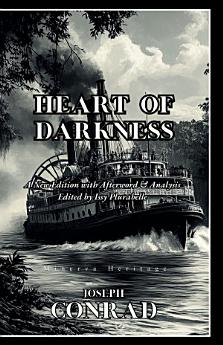
Heart of Darkness: A New Reader's Edition
About this ebook
Joseph Conrad's 1899 novella Heart of Darkness is a critique of European colonialism, framed as a layered story within a story. The story follows sailor Charles Marlow as he recounts his journey into the Congo Free State, then under King Leopold II's exploitative regime, to retrieve Kurtz, an ivory trader whose ideals have warped into ruthless megalomania. Through fragmented, impressionistic prose, Conrad exposes the moral hypocrisy of imperialism, juxtaposing rhetoric of "civilization" with scenes of dehumanization and greed. The novella's symbolism, darkness, fog, the river, is a metaphor for the ambiguity of morality and the psychological unraveling of those who wield unchecked power. While celebrated for its early anti colonial stance, modern scholars critique its Eurocentric viewpoint and marginalization of African voices, showing the era's racial prejudices. Drawing from Conrad's own traumatic voyage to the Congo, the work remains a cornerstone of postcolonial discourse and a precursor to literary Modernism. In this edition, Heart of Darkness appears with an afterword, extensive reference materials including a timeline of Conrad's life and works, character glossary and group discussion questions on this literary classic. Heart of Darkness has been lightly edited for contemporary readability, with attention to outdated terminology.
This novel is a voyage into the abyss where river currents whisper secrets and shadows breathe. Heart of Darkness is a fever dream of imperialism, where the Congo's jungles coil like a primeval serpent around Marlow's steamboat, swallowing light and sanity. Through veils of mist and madness, the myth of Kurtz unravels, a "civilized" genius turned ivory cloaked tyrant, his soul gnawed hollow by greed. The air thrums with unseen horrors: skeletal natives, rusted chains, and the hollow chant of "Exterminate all the brutes!" As Marlow drifts deeper, the line between savagery and civility blurs; the river becomes a mirror showing humanity's core, blackened by ambition. Kurtz's final gasp, "The horror! The horror!", echoes like a funeral bell for enlightenment's lie. Conrad's prose swirls, thick and suffocating, a chiaroscuro of colonialism's rot. Not just a journey through a continent, but a descent into the labyrinth within, where every heart holds a darkness waiting to stir.
Rooted in Conrad's 1890 Congo experiences, it remains central in postcolonial studies and influenced adaptations like Coppola's Apocalypse Now.