About this ebook
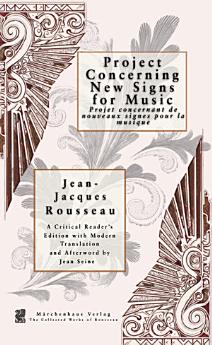
In other words, he would abbreviate musical rules so thoroughly that theory became almost a game and performance would depend only on natural habit, not on intellectual struggle. Practically speaking Rousseau claimed this numeric notation would drastically cut learning time (he claimed students would master the new system "in two or three times less time than by the ordinary method") and even allow lay amateurs to sight read tunes immediately. More philosophically, the scheme embodied Enlightenment ideals of clarity and accessibility: as one commentator notes, Rousseau saw his reform as a complete reworking of music's "language" with the goal of making it "more human, less professional"This professional translation delivers scholarly depth with supporting materials. The edition of Project Concerning New Signs for Music supplements the text with an afterword tracing Rousseau's intellectual relationship with Diderot, Voltaire and his reception by Nietzsche, revealing the detailed dialogue between the period's most influential minds. The supporting chronology for Project Concerning New Signs for Music connects the major events of Rousseau's life with world events, a glossary of Enlightenment terminology frames Rousseau's debates in the intellectual milieu of his day, and a detailed index provides an guide to his complete writings.
The Académie's response was courteous but finally unsupportive. An official report praised Rousseau's manuscript as "made with art and stated with great clarity," but declined to endorse it. The evaluators argued that the idea was neither new nor sufficiently useful: a century earlier a Cordelier monk (Père Souhaitty) had already proposed the same numeric scheme, and the Academy required that any proposal be both novel and advantageous. In short, Rousseau's numeric notation was set aside. This setback quickly redirected his career toward the broader Enlightenment scene: after 1742 he turned to writing and soon joined Diderot's Encyclopédie project (in fact, by 1744 he "began to write work in the Encyclopédie"). In the wider setting of 18th century musical theory, which was by now dominated by Rameau's mathematically oriented harmony, Rousseau's emphasis on simplicity and performer immediacy stood out. He would later clash openly with Rameau and others, insisting that music's value lies in melody and human emotion rather than abstract rules. In retrospect, the Projet des nouveaux signes shows Rousseau's early Enlightenment agenda: a rational reform intended to democratize the art of music. By seeking to make notation as intuitive as possible, he was applying the same ideals of reason, clarity and education that would shape his later works. In Rousseau's own terms, he in practice treated musical notation itself as a human "language" to be simplified for the benefit of all.