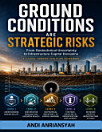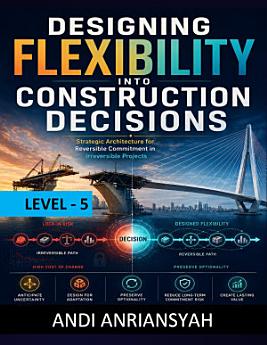
About this ebook
Across industries and geographies, large-scale projects consistently suffer from cost overruns, delays, and structural rigidity—not because of technical failure, but because critical decisions are made before sufficient knowledge exists to justify them. This book argues that the real problem is not uncertainty, but the way organizations commit under uncertainty.
Drawing on years of experience at the interface between geotechnical reality and project decision-making, Andi presents a rigorous framework for understanding how commitments form, harden, and propagate through infrastructure systems. He introduces the concept of commitment architecture—the system of physical, contractual, financial, and organizational decisions that determine whether a project remains adaptable or becomes locked into fragile assumptions.
Through structured analysis and cross-disciplinary insights, this book explores:
- Why construction is structurally irreversible—and why most frameworks fail to account for it
- How early design and contract decisions silently become capital locks
- The mechanics of the commitment cascade, where early assumptions eliminate future options
- Why traditional risk management fails to preserve strategic flexibility
- How to design projects that maintain optionality without sacrificing execution discipline
This is not a book about how to build.
It is a book about how to decide—before building begins.
Written for developers, infrastructure investors, project directors, and government decision-makers, this work provides a new lens for evaluating risk, timing commitment, and preserving value in long-horizon projects.
Because in infrastructure, the cost of being wrong is not paid when failure occurs—
it is locked in when the decision is made.
Discover more
Ratings and reviews

- Flag inappropriate

- Flag inappropriate

- Flag inappropriate
About the author
Andi Anriansyah is a strategic engineering and capital architecture advisor with over seventeen years of experience working at the interface between geotechnical reality and large-scale project decision-making. His work spans complex infrastructure environments where subsurface uncertainty, engineering design, commercial constraints, and institutional pressures converge. Throughout his career, he has contributed to technical assessments and project coordination processes that directly influence high-stakes investment and execution decisions.
Rather than focusing solely on technical solutions, Andi’s work centers on the structure of decisions themselves—how commitments are formed, when they are made, and how they shape long-term project outcomes. Drawing from practical experience and cross-disciplinary research in engineering, finance, and decision science, he develops frameworks that help organizations navigate uncertainty, preserve flexibility, and avoid premature lock-in. Designing Flexibility into Construction Decisions is his attempt to formalize these insights into a coherent discipline for modern infrastructure development.