About this ebook
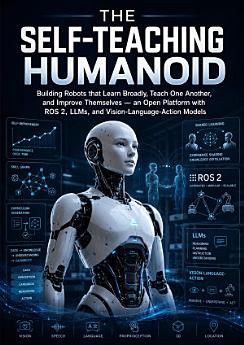
What if a humanoid robot did not merely run the behaviours its makers gave it — but learned the way a person does: broadly, from everyone, and without end?
The Self-Teaching Humanoid is a complete, buildable blueprint for exactly that machine. Across six connected parts, it carries a single idea from first principle to a running, open system: that a humanoid should learn broadly from every available source, learn from and teach other robots, improve itself through its own experience — and do all of it in the open, and in service of the people around it.
This is not speculation about a distant future. Every concept is built in working code and mirrored by a full companion repository — a runnable back end, front-end control surfaces, a simulated robot, and a real safety architecture — so you can read an idea, then run it.
What you will build and understand:
The body and its nervous system. The physical machine, its ROS 2 substrate, and the modular, encapsulated design that makes everything else possible.
Broad learning. Pipelines that turn the ocean of human video, the precision of a good teacher, the pooled experience of a whole fleet, and a robot's own imagination into skill.
The dual-system mind. A deliberative planner powered by large language models paired with a fast vision-language-action (VLA) policy — grounded in perception and memory, and governed by a safety monitor with the authority to refuse.
The self-improving learner. A skill graph, practice in imagination, a self-set curriculum, and learning from failure — and, at its furthest frontier, the hard question of self-replication, kept firmly bound to human authority.
The open platform. A studio where anyone can teach a robot, a marketplace where skills are shared and sold, a trading floor where robots spar and swap models, and a standard layer that lets one robot's skill run safely on another.
The whole system, deployed. Every layer assembled, taken from crate to safe operation, run as a fleet, and opened to all.
What sets this book apart
One commitment runs through every chapter: human safety and wellness sit above every other objective — not as a reluctant constraint, but as the entire point. That principle is built into every layer, from the body's physical limits to the mind's veto, from the platform's verification-and-recall to the commissioning gate a machine must pass before it is ever switched on.
The second discipline is encapsulation: clean interfaces and hidden internals, applied from a single skill to the whole platform. It is what lets a system this large be built, understood, and extended one piece at a time — and why the companion code can mirror the book so exactly.
Who this book is for
Robotics and ML engineers, ambitious developers, researchers, and technical founders who want more than theory — who want the architecture, the code, and the judgement to build capable humanoids the right way. A working knowledge of Python helps; the ideas are taught from the ground up.
The age of learning machines is beginning. This is the field guide to building them broadly, openly, and safely. Scroll up and get your copy today.
Discover more
Ratings and reviews
About the author
Chong Lip Phang is a seasoned web and mobile app developer in Malaysia. He has been writing computing books for the past 10 years.
The mobile game he created, Quiz Jungle ( https://quizjungle.click ), features multiplayer quiz games on various subjects. In the game, all the animals talk, interact with one another, and have intelligence literally.
One of the books he published, Mastering Front-End Web Development, has won seven awards from Book Authority.