About this ebook
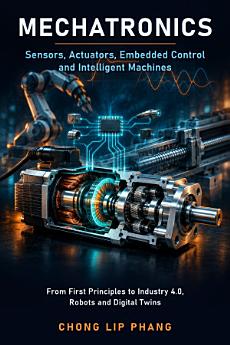
Mechatronics is a complete, modern textbook for engineering undergraduates and serious makers. It covers everything the classic mechatronics courses teach — sensors, actuators, signal conditioning, microcontrollers, modelling, control, PLCs and fluid power — and adds what today's industry actually uses: field-oriented motor control, IEC 61131-3 Edition 4 (2025), EtherCAT, IO-Link, OPC UA and MQTT, ISO 13849-1:2023 functional safety and ISO 10218:2025 cobot safety, TinyML on microcontrollers, digital twins and virtual commissioning.
Theory is complete and always worked: Laplace and z-transforms, Bode plots and root loci, state space, PID, LQR and the Kalman filter, each with numeric examples checked in Python. And theory always lands on hardware you can build for a modest budget.
Three lab benches run through the book:
MotorLab — a DC gearmotor with an encoder, current sensing and an ESP32-S3, used for modelling, system identification, PID, digital control and field-oriented control of a brushless motor.
Balancer — a two-wheeled self-balancing robot for state space, LQR and sensor fusion.
SortCell — a desktop conveyor sorting cell with industrial sensors, a stepper pusher, pneumatics, an emergency-stop circuit and a soft PLC running CODESYS or OpenPLC, connected over Modbus TCP and OPC UA to a Python digital twin.
The capstone adds a vision-guided pick-and-place gantry and walks through requirements, design, wiring, software, testing and the design review.
Current to October 2026, with more than 250 listings: Python simulations run with their real output, ESP32-S3 and Raspberry Pi Pico 2 firmware compiled with Arduino CLI, Structured Text compiled with an IEC 61131-3 compiler, circuits simulated in ngspice and Verilog simulated in Icarus. Every chapter ends with graded problems, with answers to the odd-numbered ones at the back.
What you will learn
Foundations: the mechatronic design process and the VDI/VDE 2206 V-model, measurement uncertainty and calibration, and the maths and Python toolkit.
Electronics for mechatronics: switching inductive loads, op-amp signal conditioning, 4–20 mA loops, power converters, H-bridges and inverters, batteries, grounding, EMC and PCB design in KiCad 10.
Embedded computing: microcontrollers, timers and PWM, encoder decoding, ADC sampling synchronised to PWM, UART, I²C, SPI and CAN, real-time software with FreeRTOS, data acquisition and digital filters.
Sensors: encoders, resolvers, proximity and time-of-flight sensors, MEMS inertial sensors, strain gauges and load cells, temperature, flow and level, cameras and LiDAR.
Actuators and drives: gears, ball screws and reducers, solenoids, brushed DC, stepper, brushless and induction motors, VFDs and servo drives, pneumatics, hydraulics, piezo and smart-material actuators, and how to size them.
Modelling and control: mechanical, electrical, fluid and thermal models, frequency response and vibration, system identification, PID with anti-windup, lead–lag design, digital control in fixed point, state feedback, observers, LQR, Kalman filtering, motion profiles, MPC, sliding-mode, adaptive, fuzzy and iterative learning control.
Industrial automation: PLCs in ladder, FBD, Structured Text and SFC, PackML, Modbus, PROFINET, EtherCAT, IO-Link, HMI and SCADA, OPC UA, MQTT, IEC 62443 and machine safety.
Industrial robots and intelligent machines: robot kinematics and cobots, AGVs and AMRs, CNC machines and motion controllers, industrial machine vision, TinyML, digital twins, hardware-in-the-loop testing, condition monitoring and reliability.
Mechatronics in practice: case studies of cameras, washing machines, hard disk drives, 3D printers, robot vacuums, engine management, ABS, electric vehicles, e-bikes and drones.
Results from simulations are labelled as predictions, never presented as measurements, and every version, price and standard edition is dated. Whether you are studying for an engineering degree or building your first automated machine, this book takes you from first principles to systems that work.
Discover more
Ratings and reviews
About the author
Chong Lip Phang is a seasoned web and mobile app developer who has been writing computing books since 2013.