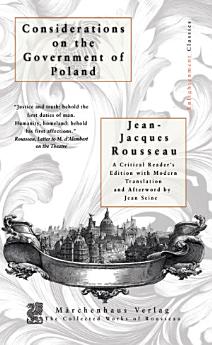
Considerations on the Government of Poland: A New Reader's Edition
About this ebook
Considerations on the Government of Poland emerged from a specific historical request and is one of Rousseau's most practical political works. A Polish political leader commissioned it to seek advice on how to best structure and reform the Polish government. Considerations on the Government of Poland (1772) was Rousseau's attempt to apply the abstract principles of The Social Contract to concrete political problems. Rousseau, Jean Jacques. Rousseau, Judge of... The work was written during a critical period in Polish history when the nation was under increasing pressure from neighboring powers, especially Russia. Poland needed to reform its political institutions to maintain independence. Unlike his more theoretical works, this treatise shows Rousseau's engagement with the practical questions of constitutional design and political reform within existing social and historical constraints. Despite its completion during his lifetime, Considerations on the Government of Poland was not published until 1782, though manuscript copies circulated from 1773.
The essay reveals Rousseau's sophisticated understanding of political realism and cultural preservation in the face of external threats. Considerations on the Government of Poland is generally considered a practical rather than philosophical work, exemplifying Rousseau's willingness to compromise his moral and political principles in the face of concrete realities and limitations. The work emphasizes the weight of national character and cultural distinctiveness as foundations for political independence. It argues that Poland must strengthen its unique institutions and customs to resist foreign domination. Rousseau advocated for gradual constitutional reform rather than radical change, recognizing that Poland's survival depended on maintaining social cohesion while adapting to external pressures. Thus, the treatise is a testament to Rousseau's ability to balance idealistic political philosophy with pragmatic statecraft, offering concrete recommendations for education.
Alongside the translation of Considerations on the Government of Poland, the edition provides contextual material on Rousseau's world and intellectual influence. Scholarly supporting material accompanies the translation of Considerations on the Government of Poland. This presentation of Considerations on the Government of Poland adds an afterword tracing Rousseau's intellectual relationship with Diderot, Voltaire and his reception by Nietzsche, revealing the detailed dialogue between the period's most influential minds. To frame Considerations on the Government of Poland, the edition provides a timeline that connects the major events of Rousseau's life with world events, a glossary of Enlightenment terminology frames Rousseau's debates in the intellectual milieu of his day, and a detailed index provides an guide to his complete writings.