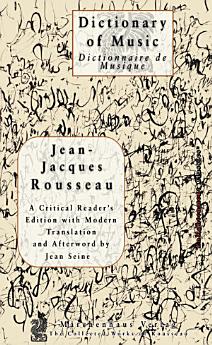
Dictionary of Music: A New Reader's Edition

· The Collected Works of Jean Jacques Rousseau Book 21 · Märchenhaus Verlag
Ebook
631
Pages
Eligible
40% price drop on Oct 28

About this ebook

The "Dictionnaire de Musique" is Rousseau's most complete and lasting work on musical scholarship, emerging from a difficult publication history that shows his evolving intellectual priorities. Originally conceived as a corrective to his earlier musical articles for the Encyclopédie project with Diderot and d'Alembert, the work underwent large revision and expansion over several years. Rousseau completed the manuscript in 1764 at Motiers Travers, obtained the publishing privilege in Paris on April 15, 1765, but delayed publication until 1768, when it appeared under the imprint of Duchesne in Paris. The work's extended gestation period allowed Rousseau to develop his musical theories more systematically and to integrate his aesthetic philosophy with practical musical knowledge, resulting in what many scholars discuss the first modern music dictionary.

Its creation followed his controversial Lettre sur la musique française (1753), which had ignited the "querelle des Bouffons" by favoring Italian opera's melodic simplicity over the perceived artificiality of French music. The work articulates a mimetic theory of musical expression that prioritizes melody over harmony, advancing the philosophical position that music achieves its highest function through direct representation of natural emotional states rather than through difficult harmonic constructions. This aesthetic structure shows Rousseau's broader commitment to immediacy and transparency in human communication, positioning music as a privileged form of intersubjective expression that transcends the artificial conventions of social discourse. The dictionary's conceptual architecture reveals Rousseau's phenomenological approach to musical experience, studying how sonic phenomena generate meaning through their capacity to recall natural sympathies between individuals while circumventing the mediating structures that corrupt ordinary linguistic communication.

This volume gathers definitions, history, and polemic. Rousseau praises melody, condemns pedantic harmony, and supplies anecdotes from folk practice. It serves both amateurs and nationalists seeking fuel for the Italian cause in Paris. His hatred of academic jargon matches his earlier attack on the sciences. Voltaire derides the book as "little tunes and big talk," while Diderot worries that Rousseau's scorn for theory may stunt musical study. Hobbes remains silent here, yet Rousseau's doubt that art improves souls without moral training fits Hobbes's bleak view of human passions, though Rousseau blames artifice, not nature.

For Dictionary of Music, the translated text is supplemented by material on Rousseau's life, context, and later reception. This edition of Dictionary of Music pairs the translation with scholarly contextual material. The edition of Dictionary of Music supplements the text with an afterword tracing Rousseau's intellectual relationship with Diderot, Voltaire and his reception by Nietzsche, revealing the detailed dialogue between the period's most influential minds. The supporting chronology for Dictionary of Music connects the major events of Rousseau's life with world events, a glossary of Enlightenment terminology frames Rousseau's debates in the intellectual milieu of his day, and a detailed index provides an guide to his complete writings.

The "Dictionnaire de Musique" is Rousseau's most complete and lasting work on musical scholarship, emerging from a difficult publication history that shows his evolving intellectual priorities. Originally conceived as a corrective to his earlier musical articles for the Encyclopédie project with ...

Discover more

About the author

Jean Jacques Rousseau (1712 to 1778) was a Genevan writer, philosopher, and composer. He wrote on political authority, inequality, education, language, music, religion, and autobiography; his books include Discourse on Inequality, The Social Contract, Emile, Julie, and the Confessions.

Rate this ebook

Tell us what you think.

Reading information

Smartphones and tablets
Install the Google Play Books app for Android and iPad/iPhone. It syncs automatically with your account and allows you to read online or offline wherever you are.
Laptops and computers
You can listen to audiobooks purchased on Google Play using your computer's web browser.
eReaders and other devices
To read on e-ink devices like Kobo eReaders, you'll need to download a file and transfer it to your device. Follow the detailed Help Center instructions to transfer the files to supported eReaders.