About this ebook
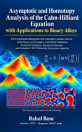
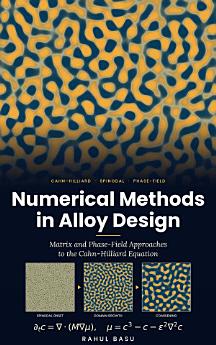
The book develops matrix methods, finite-difference and Fourier spectral schemes, quasi-steady reductions and classical matrix exponential techniques (Putzer and Apostol formulas) side by side. Each is tested on spinodal-alloy benchmarks with worked numerical examples. You will see how to check mass conservation and free-energy decay, compare Newton–conjugate-gradient steady-state solvers, study interface width and parameter effects, and verify numerical results against analytical solutions (tanh interfaces, travelling waves, Laplace-transform and series solutions).
The second half applies these methods to real alloy design problems:
order–disorder transformations and the Allen–Cahn equation superalloys and gamma/gamma-prime microstructures high-entropy alloys steels and Fe–Cr spinodal systems amorphous alloys and bulk metallic glasses ceramics, oxides and battery-electrode particles nanoalloys and size-dependent phase separation miscibility gaps and CALPHAD-style free-energy inputs What you get
26 chapters moving from theory to implementation, plus a model spinodal alloy used as a running example ready-to-run Python and MATLAB programs, with the complete source printed in the appendices symbolic solutions using Wolfram Language literature reviews, annotated references and a consolidated bibliography a subject index and an index of numerical examples Whether you are building a phase-field simulation, choosing a time-stepping scheme, checking a code against analytical results, or screening composition and temperature in a miscibility-gap design, this book gives you the methods and the code to start.
Keywords: Cahn–Hilliard equation, spinodal decomposition, phase-field modelling, alloy design, microstructure simulation, coarsening, matrix exponential, spectral methods, Python, MATLAB, computational materials science.
Discover more
About the author
Rahul is a researcher and educator in computational materials science, specializing in phase-field modelling, numerical methods, and alloy microstructure evolution. His work connects mathematical theory with practical simulation tools to help researchers understand and predict phase separation in advanced materials. Rahul has advanced degrees from UCLA, Caltech, Eurotech and has worked at various places including California, RTP, USA, and is a retired scientist from DRDO, India ( Min of Defence ).