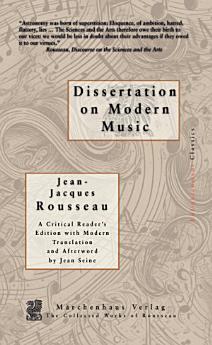
Dissertation on Modern Music: A New Reader's Edition

· The Collected Works of Jean Jacques Rousseau Book 4 · Märchenhaus Verlag
Ebook
139
Pages
Eligible
18% price drop on Oct 28

About this ebook

Dissertation on Modern Music was Rousseau's first major publication, printed in Paris in 1743 when he was thirty years old. For Dissertation on Modern Music, the translated text is supplemented by material on Rousseau's life, context, and later reception. The translation of Dissertation on Modern Music is accompanied by scholarly supporting material. The edition of Dissertation on Modern Music supplements the text with an afterword tracing Rousseau's intellectual relationship with Diderot, Voltaire and his reception by Nietzsche, revealing the detailed dialogue between the period's most influential minds. Among the reference materials for Dissertation on Modern Music, a timeline connects the major events of Rousseau's life with world events, a glossary of Enlightenment terminology frames Rousseau's debates in the intellectual milieu of his day, and a detailed index provides an guide to his complete writings.

At its heart lies a new plan for a numerical musical notation that promised to make reading and writing music more accessible. Rousseau thoroughly explains how the numbers 1 through 7 can replace traditional notes, with clever use of dots and spacing to indicate rhythm and octave shifts. In proposing this system, he challenged the "artificial" conventions of the French musical establishment, the detailed clefs, keys, and accidentals of standard notation, which he believed imposed unnecessary structure. The treatise methodically argues that music should be grounded in natural principles, mirroring the human voice and simple folk melody, rather than constrained by what Rousseau saw as the overly elaborate rules of modern composition.

Beyond its technical scheme, the work is rich in musical and philosophical understanding. Rousseau uses the opportunity to reflect on the state of modern music, critiquing how far it had strayed from what is innately expressive and human. He contends that the taste of his time favored showy virtuosity and harmonic artifice at the expense of genuine emotional communication. In clear and passionate prose, yet with a neutral, analytical tone, Rousseau calls for a return to simplicity and clarity in musical art, a theme that foreshadows his later belief in returning to nature in society and education. Historically, this 1743 dissertation is a pioneering Enlightenment text on music theory, one that weds practical reform with Enlightenment ideals. Though initially met with skepticism (the French Academy of Sciences dismissed his notation scheme as not entirely original, even as they praised his lucid presentation), Rousseau's Dissertation endures as a document of its time's intellectual daring.
Dissertation on Modern Music was Rousseau's first major publication, printed in Paris in 1743 when he was thirty years old. For Dissertation on Modern Music, the translated text is supplemented by material on Rousseau's life, context, and later reception. The translation of Dissertation on Modern...

Discover more

About the author

Jean Jacques Rousseau (1712 to 1778) was a Genevan writer, philosopher, and composer. He wrote on political authority, inequality, education, language, music, religion, and autobiography; his books include Discourse on Inequality, The Social Contract, Emile, Julie, and the Confessions.

Rate this ebook

Tell us what you think.

Reading information

Smartphones and tablets
Install the Google Play Books app for Android and iPad/iPhone. It syncs automatically with your account and allows you to read online or offline wherever you are.
Laptops and computers
You can listen to audiobooks purchased on Google Play using your computer's web browser.
eReaders and other devices
To read on e-ink devices like Kobo eReaders, you'll need to download a file and transfer it to your device. Follow the detailed Help Center instructions to transfer the files to supported eReaders.