About this ebook
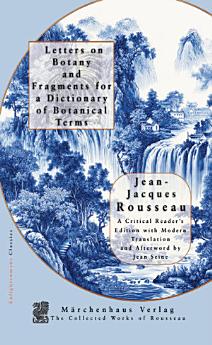
Alongside the translation of Letters on Botany and Fragments for a Dictionary of Botanical Terms, the edition provides contextual material on Rousseau's world and intellectual influence. The translation of Letters on Botany and Fragments for a Dictionary of Botanical Terms is accompanied by scholarly supporting material. The edition of Letters on Botany and Fragments for a Dictionary of Botanical Terms supplements the text with an afterword tracing Rousseau's intellectual relationship with Diderot, Voltaire and his reception by Nietzsche, revealing the detailed dialogue between the period's most influential minds. For Letters on Botany and Fragments for a Dictionary of Botanical Terms, a timeline connects the major events of Rousseau's life with world events, a glossary of Enlightenment terminology frames Rousseau's debates in the intellectual milieu of his day, and a detailed index provides an guide to his complete writings.
In 1771, at nearly sixty years old, Rousseau embarked on a series of eight letters on botany for the young daughter of a friend, aiming to spark the child's curiosity about the natural world. Unlike the formal scientific treatises of his day, Rousseau's botanical letters avoid Latin jargon and read like a friendly conversation, guiding the student to observe each plant's form and structure with patient attention. Though not published until after his death in 1778, the letters earned wide acclaim for their pedagogical clarity and gentle enthusiasm, Johann Wolfgang von Goethe praised the collection as a model of science education that beautifully complemented the philosophy of Emile.
Although composed between 1771 and 1774, Rousseau's Elementary Letters on Botany did not appear in print until 1782, four years after his death. This collection of letters, translated into English by 1785 as Letters on the Elements of Botany, revealed Rousseau as a gentle tutor teaching basic botany in the form of personal correspondence. Each letter guides the young recipient through a lesson about plants: explaining the structure of flowers and leaves, or introducing the Linnaean system of classification, all in simple, vivid language. Conscious that a child or layperson might be intimidated by scientific jargon, Rousseau avoids Latin terminology and stuffy formalities, opting instead for clear descriptions drawn from direct observation of nature. His tone is affectionate and patient, turning the study of botany into a delightful adventure, one that instructs in science and instills a spirit of wonder toward the natural world.
Rousseau's 1782 Fragments for a Dictionary of Botanical Terms (Fragments pour un Dictionnaire des termes de Botanique) is his last botanical effort and took the form of an unfinished glossary of plant terminology. In these pages he attempts to catalogue botanical vocabulary and explain plant anatomy, revealing his lasting fascination with the natural world even as his life was ending. Though this dictionary never became the master work he planned, its publication enriched Rousseau's portrait as a nature lover and proto ecologist. It is often bound with his Letters on the Elements of Botany (1773) as evidence of his ecological interests. In these notes Rousseau expresses respect for the beauty and diversity of plants and urges caution against reducing nature to human uses. From a historical viewpoint, the volume matters as an example of Enlightenment natural history: it shows Rousseau engaging with modern science, defending precise language, and subtly criticizing agricultural and medical authorities. Today readers interested in the history of science find it illuminating as Rousseau's work on botanical learning and as a reflection of his broader philosophy that human well being is connected to understanding the natural world.