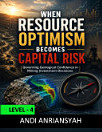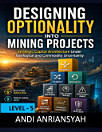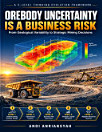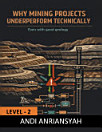
About this ebook
They fail in the space between what is known and what is decided.
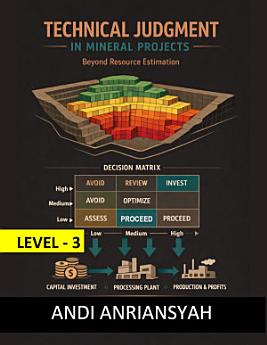
Technical Judgment in Mineral Projects addresses a critical but largely invisible gap in the mining industry: the translation of technically sound estimation into high-stakes capital decisions. Despite advances in geology, resource modeling, and engineering, projects continue to underperform—delivering lower grades, higher costs, and reduced value compared to pre-production forecasts.
This book argues that the problem is not estimation.
It is judgment.
Written for experienced geologists, mining engineers, metallurgists, and project decision-makers, this work introduces technical judgment as a structured discipline—one that goes beyond models, beyond compliance, and into the realm of decision quality under uncertainty.
Through a rigorous framework, the book explores:
- Why model quality does not guarantee decision quality
- How assumptions silently propagate from drill data to NPV
- Where geological, metallurgical, and geotechnical uncertainty truly matters
- Why sensitivity analysis often creates false confidence
- How cognitive bias shapes technical decisions in high-pressure environments
Across real-world composite cases, readers are guided through the hidden failure modes that repeatedly undermine mineral projects—and shown how to identify them before capital is committed.
This is not a book about how to build better models.
It is a book about how to make defensible decisions when models are not enough.
For professionals operating at the intersection of technical rigor and financial consequence, this book provides a new lens—and a necessary discipline—for navigating uncertainty in mineral project development.
Discover more
Ratings and reviews

- Flag inappropriate

- Flag inappropriate

- Flag inappropriate
About the author
Andi is a Senior Technical Professional (Mineral Systems & Decision Integration), with 17 years of experience contributing geological input across mineral project environments — from early-stage exploration through resource estimation, technical studies, and development-stage decision support, working alongside mine planners, project engineers, and senior management teams.
His work has been built at the intersection of geological knowledge and decision quality. He has contributed as technical specialist and independent reviewer — working alongside study managers, senior engineers, and project leaders on projects spanning nickel, coal, and gold across Indonesian and cross-industry project environments, with exposure to international technical practice through professional study and engagement. His particular focus has been on the moments where technical work transitions into consequential decisions — the scoping-to-PFS gate, the prefeasibility-to-feasibility commitment, the construction approval — and on the systematic judgment failures that consistently occur at those transitions.
He has contributed to technical reviews in which the geology was correctly modeled and the mine still underperformed. Through his work alongside senior technical advisors, study managers, and project leaders, he has been close to the moments — in project reviews, management discussions, and capital-stage presentations — where the sensitivity analysis was technically correct and the decision structurally misinformed. He has witnessed, through those collaborative environments, projects fail not because the block model was wrong but because the uncertainty that the block model honestly represented was quietly discarded in the translation to a mine plan and a financial model.
This book is the accumulated product of those observations — a structured attempt to make explicit the discipline that separates technically competent work from technically sound decisions.