About this ebook
Everyone agreed.
Everyone moved on.
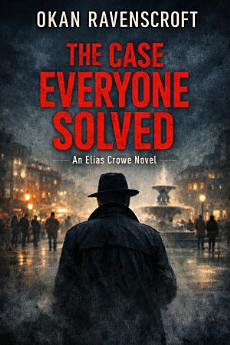
In The Case Everyone Solved, investigator Elias Crowe arrives too late to stop a death—and too early to accept the ending.
A man is killed in broad daylight in a crowded city square. Dozens of witnesses come forward. Cameras capture the moment. The media delivers a clean, confident narrative within hours. A hero emerges. A suspect cooperates. The case closes almost before it begins.
But Crowe notices something that no one else does.
Not what happened—but how it was told.
As Crowe speaks to witnesses one by one, their certainty begins to fracture. The words they use feel familiar. Their timelines align too neatly. Their memories seem shaped by the story that formed around them rather than the moment they lived through. Everyone talks. No one stays silent. And yet the truth keeps slipping further away.
This is not a novel about a hidden killer.
It is a novel about how endings are manufactured, how responsibility dissolves inside crowds, and how quickly certainty can replace understanding. With razor-sharp dialogue and mounting psychological tension, The Case Everyone Solved turns the classic detective story inside out, asking not who committed the crime—but who needed it to be over.
Cool, precise, and deeply unsettling, this novel introduces Elias Crowe as a detective for our age: a man less interested in confessions than in contradictions, and more dangerous to systems than to criminals.
Because some cases are closed for a reason.
And those are the ones worth reopening.
Discover more
Ratings and reviews
About the author
Okan Ravenscroft was born on September 9, 1988, in Istanbul, Turkey. He completed a four-year university education in Economics, a background that strongly influences his structured thinking and thematic depth as a writer.
With a brother who works as a film critic, Ravenscroft grew up immersed in cinematic storytelling, which is reflected in his vivid imagery and carefully constructed narrative pacing. His writing primarily explores crime, psychological tension, and moral ambiguity, often focusing on the intersections of media, justice, and personal conscience.
Married and the father of a six-year-old daughter, Ravenscroft believes that family life brings emotional depth and realism to his work. Through his stories, he aims to give voice to the unheard, challenge comfortable truths, and confront readers with unsettling yet essential questions about modern society.