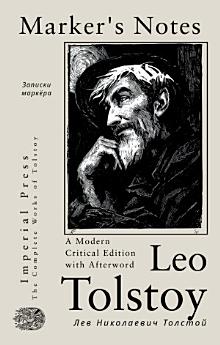
Marker's Notes
About this ebook
"Marker's Notes," or "Записки маркёра" in Russian, was written in September 1853 during Tolstoy's leave from military service in the Caucasus, where he visited his sister in Zheleznovodsk. The story was first published in 1855 in the journal "Современник" (Sovremennik) under the initials "L. N. T.". This work delves into a broad spectrum of psychological, socio ethical, and worldview questions that preoccupied Tolstoy during the 1850s. It employs the genre of "notes" and first person narration, allowing for a many sided plot and detailed psychological analysis. The story features two distinct characters who also serve as narrators, a marker and Nekhlyudov, contrasting in age, social standing, and speech patterns.
The story's dual viewpoint serves to dramatically portray Nekhlyudov's isolation and the stark disconnect between the worldview of the nobility and that of the common people. The expressive language of the narrator, especially at the story's conclusion, elevates the work to an existential plane, prompting contemplation on the basic conditions of human existence. "Marker's Notes" exhibits connections to the traditions of the "natural school" in Russian literature, a movement characterized by its realistic depiction of social conditions and its focus on the lives of ordinary people.
This critical reader's edition presents a modern translation of the original manuscript, crafted for the modern reader with clean, modern language and simplified sentence structures that clarify his difficult Russian phrasing and specific antiquated references. Supplementary material enriches the text with autobiographical, historical, and linguistic setting, including an afterword by the translator on Tolstoy's personal history, impact, and intellectual legacy, an index of the philosophical concepts he employs, giving attention to Existentialism and influence by Schopenhauer, a complete chronological list of his published writings, and a detailed timeline of his life, showing the personal relationships that shaped his philosophy.