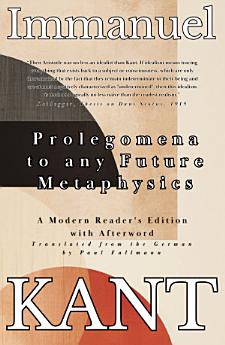
About this ebook
The Prolegomena was published two years after the first edition of the Critique of Pure Reason and summarizes the Critique's essential arguments utilizing phraseology and lines of though not present in the first edition. This was intended by Kant as a simplified and clear presentation of the Critique, and he would later work some of these summaries back into later versions of the Critique. It is a hostile polemic against the initial criticisms from specific authors and broadly against the Empiricism of Deterministic Causality and attempts to chart an Ontotheology based on the internal ordering of the mind and soul. Here he returns to the basic ideas of his Metaphysics and lays the foundation for a Metaphysical science that is as respected as mathematics or physics.
Just like the Critique, the Prolegomena is Epistemological in nature, focusing on questions on the perception and acquisition of knowledge. Kant muses on a range of Cosmological and Noetic questions, such as how are a priori assumptions possible, or how is knowledge from pure reason possible? How is our numinal consciousness structured, and how does it "know" the world"? What is Space, time, and the cosmos, and how does God interact with or is known by the material world and its inhabitants?
This work presented a concise and accessible synopsis of the Critique of Pure Reason using an "analytic" method that worked backwards from established sciences rather than the Critique's "synthetic" study of mental faculties, written partly as a polemic after Kant was disappointed by shallow and uncomprehending reviews that dismissed his first Critique as idealism. Published two years after the Critique, the book was intended for "future teachers" of metaphysics and demanded that all metaphysical work cease until philosophers determined "whether such a thing as metaphysics is even possible at all," reframing metaphysics not as knowledge of transcendent objects but as investigation into how knowledge itself is structured. Kant distilled his inquiry into the question of whether synthetic a priori cognition is possible, studying how such cognition operates in pure mathematics and pure natural science before addressing metaphysics in general, arguing that mathematics is possible through pure intuitions of space and time as forms of sensibility while pure natural science rests on categories of understanding that the mind brings to experience. The work responded directly to a mangled anonymous review by Garve and Feder that mischaracterized his transcendental idealism, insisting that his project restricted investigation to experience and its conditions rather than claiming knowledge of things beyond experience. Written during a period when Kant felt compelled to clarify his radical rejection of rationalist metaphysics, the Prolegomena permanently shifted philosophy's emphasis from making grand claims about the universe's nature toward determining the limits and structure of what humans can know, explaining how David Hume's skepticism about causation had awakened him from his "dogmatic slumber" and driven him to ground causality and other pure concepts in the understanding itself rather than deriving them from experience.