About this ebook
Hegel
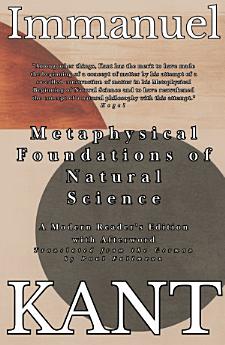
A modern translation of Immanuel Kant's paper "Metaphysical Foundations of Natural Science" from the original German manuscript first published in 1785. For Metaphysical Foundations of Natural Science, this new edition contains an afterword by the translator, a timeline of Kant's life and works, and a helpful index of Kant's key concepts and intellectual rivals. The translation of Metaphysical Foundations of Natural Science favors clear modern English, renders Kant's difficult German as directly as possible, and omits academic footnotes to keep the text accessible.
Published one year before the Critique of Pure Reasons, Metaphysical Foundations is Kant's method which would be used in his famous Critique. He attempts to deconstruct an Empiricist Epistemology and show that a priori principles, which are by nature metaphysical in nature, are necessary for the possibility of science to happen in the first place. He is reconciling the new mechanical causality concepts created by Newton with their philosophic preconceptions. While his theory of Phoronomy and movement are not useful to modern physics, this work outlines some basic Epistemological Platonic criticisms of Material Determinism which would be proven Empirically, ironically, by Einstein's Quantum theories and modern theories of perceptual consciousness. One of the most detailed work Kant brings to modern Science through this work is in Quantum Mechanics. Kant, not Newton or Einstein, was the first to posit theory of "action at a distance" which would eventually be proven by the observation of Quantum Entanglement. In the second section of this treaty, he writes Theorem 7 as "The attraction essential to all matter is a direct effect of the same on others through empty space"
This work applied Kant's critical philosophy to Newtonian physics, providing metaphysical foundations for mathematics' application to empirically given nature and establishing what conditions must be met for a body of knowledge to constitute natural science in the proper sense. Organized in quasi mathematical fashion into definitions, propositions, proofs, and remarks across four chapters corresponding to the categories of quantity, quality, relation, and modality, the book treated phoronomy (kinematics), dynamics, mechanics, and phenomenology as the metaphysical foundations of natural science. Kant developed a theory of matter grounded in interacting attractive and repulsive forces rather than the mechanistic approaches of his predecessors, arguing that matter fills space through the balance of these opposed forces and that this relation conception accounts for phenomena like gravitation acting at a distance while demonstrating matter's infinite divisibility. The preface established Kant's restrictive conception of natural science proper, requiring that cognition be systematically ordered according to rational principles and known a priori with apodictic certainty, thereby excluding chemistry and psychology from the status of genuine science since they lacked the mathematical and a priori foundations he deemed essential. Written in an inhospitable style more akin to his pre critical natural philosophy than his great critical works, the book derived analogues to Newtonian laws of motion and provided transcendental explanations for how Newton's mathematical concept of quantity of matter could be applied universally to experience. The work exerted deep influence on the rise of science departments in German speaking universities during the nineteenth century, though it received far less scholarly attention than Kant's other critical works due to its specialized content and forbidding presentation, yet it remains his major statement in philosophy of science and his most mature reflection on themes connecting his metaphysics to the natural science of his time.