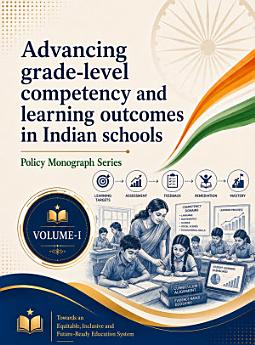
Advancing grade-level competency and learning outcomes in Indian schools: A state-level policy framework for quality, equity, assessment, and learning recovery
About this ebook
Author: Dr. Harshvardhan Singh
Published by:
Scholars Choice Press
An imprint of Educators Plus
India
Year of Publication: 2026
ISBN: 978-81-686513-0-2
Copyright © 2026 Dr. Harshvardhan Singh
All rights reserved. No part of this publication may be reproduced, stored in a retrieval system, transmitted, distributed, or used in any form or by any means—electronic, mechanical, photocopying, recording, scanning, or otherwise—without the prior written permission of the author and publisher, except for brief quotations used for academic, research, review, or policy discussion purposes with proper citation.
This policy monograph is intended for academic, policy, institutional, and professional use. The views expressed in this publication are those of the author and are intended to contribute to evidence-based discussion on school education quality, grade-level competency, learning outcomes, teacher capacity, inclusive education, assessment reform, and state-level implementation. References to government policies, public data systems, and official frameworks are used for educational and analytical purposes.
While reasonable care has been taken to ensure accuracy, the author and publisher do not claim that the recommendations contained in this monograph are exhaustive or universally applicable in every state, district, or school context. State governments, education departments, SCERTs, DIETs, BRCs, CRCs, schools, NGOs, and other institutions are advised to adapt the framework according to their local administrative structures, language contexts, learner profiles, policy priorities, and available resources.
The publication does not represent an official policy document of any government department, ministry, statutory body, or public institution unless explicitly stated. Any errors or omissions remain the responsibility of the author.
Ratings and reviews
About the author
Dr. Harshvardhan Singh is an education researcher, psychometrician, and curriculum-evaluation professional working in the areas of educational measurement, learning assessment, teacher education, inclusive education, research tool development, and school education quality. His academic and professional work focuses on evidence-based educational reform, learner diversity, pedagogical improvement, psychometric scale development, and policy-relevant educational research.
Dr. Singh’s work is situated at the intersection of educational policy, classroom practice, and measurement. He has engaged extensively with issues related to learning outcomes, teacher effectiveness, differentiated instruction, inclusive education, student support systems, diagnostic assessment, and the development of standardized and researcher-constructed tools for educational research. His academic interests include the design of valid and reliable instruments, interpretation of learner data, improvement of classroom pedagogy, and translation of research evidence into practical institutional frameworks.
A significant part of his work concerns the improvement of school education quality through assessment-informed planning and teacher capacity building. He has contributed to research and writing on educational equity, inclusive classrooms, children with diverse learning needs, specific learning disabilities, neurodiversity, pedagogical support, and the role of schools in ensuring meaningful learner participation. His policy-oriented writing emphasizes that educational reform must move beyond access and enrolment toward measurable learning, classroom support, and system-level accountability.
Dr. Singh’s professional orientation is strongly connected with the idea that learning improvement requires coordination between policy design, teacher preparation, school leadership, assessment systems, data use, and community engagement. He views educational measurement not merely as a testing activity, but as a tool for diagnosis, remediation, planning, and equity. His work advocates for practical frameworks that can be used by policymakers, SCERTs, DIETs, BRCs, CRCs, school leaders, teacher educators, NGOs, and educational researchers.
In this monograph, Dr. Singh brings together his interests in learning outcomes, competency-based education, foundational literacy and numeracy, inclusive education, socio-emotional learning, teacher capacity, diagnostic assessment, remedial support, and state-level monitoring. The proposed framework is intended to support Indian states in moving from enrolment-based schooling success to learning-assurance-based school education reform.