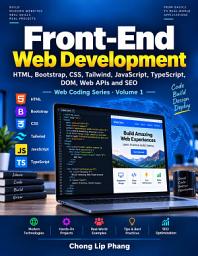
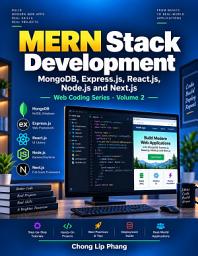
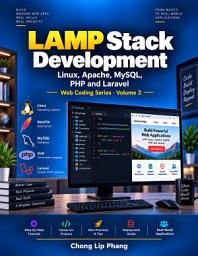
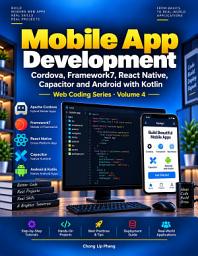
Web Coding Series
About this ebook series
The Web Coding Series: one shelf, the whole web stack. Most programming books teach a single tool and stop at its edges. Real work does not. A front-end developer is asked to style a page, wire an API, containerize the result, chase a slow query, and explain why the site does not appear in search. The Web Coding Series covers that entire span in seven volumes, each one a complete reference on its subject and all of them written to the same plan: explain the concept plainly, show a runnable example, print the output it really produces, and say what the alternatives are and when each is worth choosing.
What every volume gives you
Real output, not promises. Listings are run in a current browser, in Node.js or at the command line, and the screenshots, console logs and compiler messages printed in the book are the ones those runs produced.
Verified versions. Release numbers, browser support, licences and prices are checked against official documentation, and features that are experimental or still settling are labeled as such instead of being sold as safe.
Depth under the surface. Each topic explains how the thing actually works: how the engine parses, how the bundler resolves, how the framework re-renders, how the crawler decides.
Open source, mapped. Libraries and tools come with repository addresses, install commands, minimal usage and honest comparison tables of free and commercial options.
Useful twice. Read a volume cover to cover as a course, then keep it as the desk reference you reach for mid-task: numbered listings, captioned tables and a table of contents that takes you straight to the answer.
The seven volumes
Volume 1 — Front-End Web Development. Development environments and tooling, HTML, Bootstrap, CSS, Tailwind CSS, JavaScript, TypeScript, the DOM, the Web APIs, and search engine optimization.
Volume 2 — MERN. Node.js and the npm ecosystem, React, Express and Koa, MongoDB, and Next.js: the JavaScript stack end to end.
Volume 3 — LAMP. Linux, Apache, databases, PHP and Laravel, the stack that still runs a large share of the web.
Volume 4 — Mobile App Development. Framework7, Cordova, React Native, Capacitor and Android with Kotlin: web skills carried onto the phone.
Volume 5 — Package Managers and DevOps. Git and GitHub, Docker, Jenkins, Kubernetes and AWS CloudFormation: how code gets versioned, built, shipped and run.
Volume 6 — Web Graphics. SVG, Canvas 2D, WebGL, WebGPU, Three.js, D3.js, Babylon.js and the image generation APIs.
Volume 7 — Data Engineering. Moving, storing and streaming data behind web applications, including managed cloud Kafka.
Who it is for
Beginners who want a path that does not stop after "hello world"; working developers who need a trustworthy reference for a technology they are picking up this week; teams and students who would rather learn from examples that were actually executed than from snippets that were merely typed. Start with any volume. They share one voice, one set of conventions and one promise: if it is in the book, it was checked.
About the author
Chong Lip Phang is a seasoned web and mobile app developer in Malaysia who has been writing computing books since 2013. He created the multiplayer mobile quiz game Quiz Jungle, and his book Mastering Front-End Web Development won seven awards from BookAuthority.