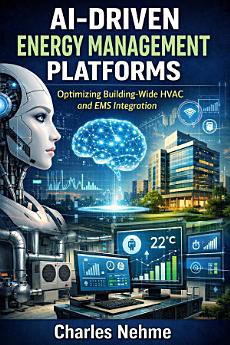
AI-DRIVEN ENERGY MANAGEMENT PLATFORMS: Optimizing Building-Wide HVAC and EMS Integration
About this ebook
This book was written for engineers, facility managers, energy consultants, technology strategists, and executives who are navigating the shift from conventional building automation systems toward intelligent, AI-driven energy management platforms. The content spans the technical foundations of modern HVAC and EMS architecture, the principles of machine learning as applied to thermal and electrical loads, the integration challenges that arise when connecting legacy infrastructure to cloud-based analytic engines, and the organizational and economic frameworks needed to justify and sustain transformation.
What distinguishes the current moment from earlier waves of building automation is not merely the sophistication of the algorithms but the convergence of three enabling forces: ubiquitous low-cost sensing, cloud-scale computing infrastructure, and open data standards that allow previously siloed systems to communicate. Together, these forces make it technically and economically feasible to manage every mechanical system in a large commercial building as a coherent, adaptive whole rather than a collection of independently controlled subsystems.
The chapters that follow move from foundational concepts to advanced deployment scenarios. Readers approaching the subject for the first time will find grounding in the physical principles of building thermodynamics and the architecture of conventional EMS platforms before encountering the AI layer. Practitioners already familiar with BAS and SCADA will be able to move quickly through early chapters and engage more deeply with the optimization algorithms, integration protocols, and cybersecurity considerations that occupy the middle and later sections.
Throughout, the emphasis is on practical applicability. Case studies drawn from commercial office buildings, hospitals, data centers, campuses, and industrial facilities illustrate how abstract optimization principles translate into measurable energy savings, carbon reductions, and operational improvements. Where technologies are still emerging, the text is explicit about current limitations and realistic expectations.
The opportunity before us is significant. Buildings that deploy AI-driven EMS platforms consistently achieve energy reductions of 15 to 30 percent compared to conventional automation baselines, with some advanced deployments reporting savings exceeding 40 percent for HVAC alone. At global scale, realizing even a fraction of this potential would represent a gigaton-class contribution to climate stabilization. The purpose of this book is to accelerate that realization by equipping practitioners with the knowledge to design, deploy, and operate these systems with confidence.
Discover more
About the author
profile https://bit.ly/m/HVAC