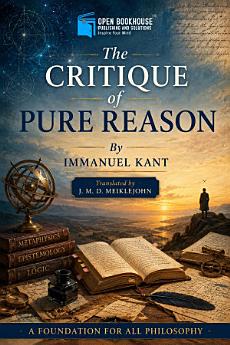
The Critique of Pure Reason: Illustrated Edition for Modern Readers | Featuring Introduction, About the Author and Book Summary
About this ebook
This Open Book House Annotated & Illustrated Edition is designed to make Kant's classic more accessible to modern readers. Based on the renowned public-domain translation by J. M. D. Meiklejohn, the volume includes a scholarly introduction, author and translator biographies, illustrations inspired by key philosophical concepts, a reader-friendly summary, and supplementary material that helps readers navigate one of the most important intellectual works ever written.
Whether you are a student of philosophy, a lifelong learner, or a reader interested in the foundations of human knowledge, this edition offers an engaging gateway into Kant's revolutionary vision of reason, experience, and reality.
About the author
Immanuel Kant (1724–1804) was one of the most influential philosophers in the history of Western thought. Born on April 22, 1724, in Königsberg, Prussia (now Kaliningrad, Russia), Kant spent nearly his entire life in his hometown, where he studied, taught, and developed ideas that would permanently transform philosophy.
Raised in a modest family, Kant demonstrated exceptional intellectual ability from an early age. He attended the University of Königsberg, where he studied philosophy, mathematics, physics, and theology. After several years working as a private tutor, he returned to the university and eventually became a professor of logic and metaphysics. His lectures attracted students from across Europe and earned him a reputation as a brilliant and disciplined thinker.
Kant's philosophical work sought to address some of the deepest questions concerning knowledge, morality, freedom, and human existence. His most famous achievement is the development of what became known as Critical Philosophy, a revolutionary approach that examined the powers and limits of human reason. This project reached its fullest expression in The Critique of Pure Reason (1781; revised 1787), widely regarded as one of the most important books ever written in philosophy.
In addition to this landmark work, Kant authored several other influential books, including Prolegomena to Any Future Metaphysics, Critique of Practical Reason, Critique of Judgment, and Groundwork of the Metaphysics of Morals. His writings laid the foundations for modern epistemology, ethics, aesthetics, political philosophy, and metaphysics. Many of the major philosophical movements of the nineteenth and twentieth centuries emerged in response to his ideas.
Beyond philosophy, Kant's influence extended into psychology, law, education, political theory, and the natural sciences. His emphasis on reason, human dignity, and moral responsibility continues to inspire scholars and readers around the world.
Despite achieving international fame, Kant lived a remarkably quiet and disciplined life. He devoted himself to teaching, writing, and intellectual inquiry, becoming a symbol of scholarly dedication. He died in Königsberg on February 12, 1804, leaving behind a body of work that remains central to philosophical study more than two centuries later.
Today, Immanuel Kant is remembered as one of humanity's greatest thinkers—a philosopher whose exploration of knowledge, reason, morality, and freedom continues to shape our understanding of ourselves and the world.
John Miller Dow Meiklejohn (1830–1902) was a distinguished Scottish educator, scholar, author, and translator whose work helped introduce some of the most important philosophical and literary texts of Europe to English-speaking readers. Best known for his English translation of Immanuel Kant's The Critique of Pure Reason, Meiklejohn played a significant role in making complex philosophical ideas accessible to a wider audience during the nineteenth century.
Born in Edinburgh, Scotland, on July 19, 1830, Meiklejohn received a strong classical education and developed a lifelong passion for languages, literature, and philosophy. He studied at the University of Edinburgh, where he excelled in the humanities and later pursued a career in education. Throughout his life, he served as a teacher, lecturer, educational reformer, and writer, earning recognition for his dedication to learning and intellectual advancement.
Meiklejohn was a prolific author who wrote extensively on education, literature, language, and philosophy. His educational works were widely used in schools and colleges, reflecting his belief that knowledge should be presented clearly and made accessible to all learners. This commitment to clarity and scholarship is evident in his translation work as well.
His translation of Kant's The Critique of Pure Reason became one of the earliest and most influential English versions of the philosopher's masterpiece. At a time when Kant's writings were largely inaccessible to English readers, Meiklejohn's translation helped bring Kant's revolutionary ideas to a broader audience. Although later translations have appeared with updated scholarship and terminology, Meiklejohn's version remains historically important and continues to be valued as a classic public-domain translation.
In addition to translating philosophical works, Meiklejohn contributed significantly to educational theory and practice. He advocated for improved teaching methods and believed that education should encourage critical thinking rather than simple memorization. His writings reflected a deep respect for intellectual inquiry and lifelong learning.
John Miller Dow Meiklejohn passed away in 1902, leaving behind a legacy as an educator, translator, and scholar. His translation of The Critique of Pure Reason remains an enduring contribution to philosophical literature, helping generations of readers engage with one of the most important works in the history of human thought.