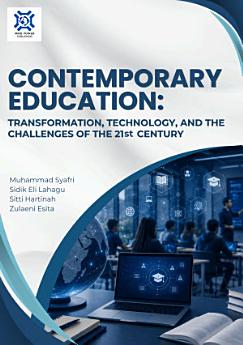
CONTEMPORARY EDUCATION: Transformation, Technology, and the Challenges of the 21st Century
About this ebook
The essence of contemporary education can no longer be understood simply as a process of transferring knowledge from educators to students, but rather as a transformative process that positions humans as active subjects in building meaning, skills, and character amidst global dynamics. In an era of disruption influenced by the industrial revolution 4.0, the development of artificial intelligence, and massive digital connectivity, education is required to be responsive to rapid and complex social, economic, and cultural changes. Progressive thoughts such as those inherited by John Dewey about experience as the core of learning, as well as Paulo Freire’s critical ideas about education as a practice of liberation, find new relevance in the context of the 21st century. Thus, the essence of contemporary education lies in its ability to integrate value transformation, the use of technology, and the strengthening of 21st-century competencies—such as critical thinking, creativity, collaboration, and digital literacy—to shape individuals who are adaptive, reflective, competitive, and civilized.