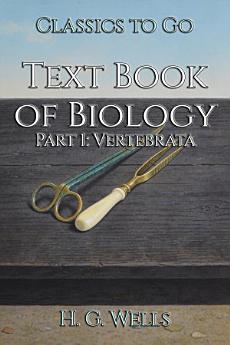
Text Book of Biology: Restored Classics to Go Edition

· Otbebookpublishing
Ebook
227
Pages
Eligible

About this ebook

H. G. Wells's Text-Book of Biology is a practical guide for students of natural science, especially those working through vertebrate anatomy, development, and examination preparation without constant access to a teacher. Born from the author's experience teaching by correspondence, it argues that real understanding comes not from memorization, but from disciplined observation, careful sketching, and the patient discovery of general principles through concrete facts. The book defends the "type system" of study, using representative organisms to build a comparative grasp of life. At its center is the rabbit, introduced as a familiar vertebrate whose body reveals the relation between structure and function: backbone, limbs, skull, tail, hair, and diaphragm all point to a life of speed, burrowing, and mammalian adaptation. The text defines essential anatomical terms, explains metabolism as the breakdown of food for energy, and traces digestion from mouth to intestine, including the distinctive cecum and appendix of the herbivore. It then broadens to the frog, whose simpler organs and skull illuminate vertebrate evolution, from reproductive and nervous systems to the cartilaginous foundations of the skull and jaw. This edition has been fully restored with modern typesetting, custom cover design.
H. G. Wells's Text-Book of Biology is a practical guide for students of natural science, especially those working through vertebrate anatomy, development, and examination preparation without constant access to a teacher. Born from the author's experience teaching by correspondence, it argues that...

About the author

H. G. Wells, born in 1866 in Bromley, England, rose from a modest background to become one of the most imaginative and influential writers of the modern age. Trained in science and deeply shaped by his studies and teaching, he brought a rare blend of analytical curiosity and social urgency to his writing, moving with ease from fiction to history, journalism, and political commentary. Over a remarkably productive career, he helped define modern science fiction while also producing ambitious social novels, speculative visions, and incisive essays that examined the forces reshaping industrial society. His work repeatedly returns to themes of scientific progress, class inequality, war, empire, education, and the moral responsibilities of invention, making him strikingly relevant in an era still wrestling with technological change and social division. Wells was not only a prophet of future possibilities but also a sharp critic of the present, warning readers that human intelligence without ethical purpose could lead to disaster. His legacy endures in the way he expanded what literature could do: entertain, provoke, and forecast the consequences of human choices. Readers who enjoy visionary fiction, social criticism, and big ideas grounded in real-world concerns will find him especially rewarding.
H. G. Wells, born in 1866 in Bromley, England, rose from a modest background to become one of the most imaginative and influential writers of the modern age. Trained in science and deeply shaped by his studies and teaching, he brought a rare blend of analytical curiosity and social urgency to his...

Rate this ebook

Tell us what you think.

Reading information

Smartphones and tablets
Install the Google Play Books app for Android and iPad/iPhone. It syncs automatically with your account and allows you to read online or offline wherever you are.
Laptops and computers
You can listen to audiobooks purchased on Google Play using your computer's web browser.
eReaders and other devices
To read on e-ink devices like Kobo eReaders, you'll need to download a file and transfer it to your device. Follow the detailed Help Center instructions to transfer the files to supported eReaders.