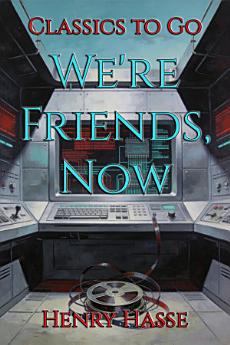
We're Friends, Now: Restored Classics to Go Edition

· Otbebookpublishing
Ebook
78
Pages
Eligible

About this ebook

Raoul Beardsley, a weary Crime-Central coordinator, approaches the most unsettling case of his career: the murder of Amos T. Carmack, the man whose patents made ECAIAC the world's infallible crime machine. In a near-future society addicted to automated justice and public spectacle, Beardsley is forced to confront not only a mountain of persona-tapes, suspects, and statistical evidence, but also his own private dread of the system he serves. The news media hypes the case while Beardsley seethes at the machine's cold authority and the way it has reduced detective work to sterile calculation. At ECAIAC's vast chamber, the machine seems almost alive, and its operator, Jeff Arnold, is increasingly tense as unexplained "excess data" and failed synaptic clearances hint at deeper instability. As reject tapes emerge and the suspects narrow, Beardsley reveals that powerful figures are entangled in the murder: Minister of Justice George Mandleco, Professor Karl Losch, Brook Pederson, and even Arnold himself. When the machine suddenly breaks down in a blaze of smoke and chaos, Beardsley's suspicion hardens into resolve. He takes command, determined to solve a case that may expose the limits of machine logic and the dangerous human motives hidden beneath it. This edition has been fully restored with modern typesetting, custom cover design.
Raoul Beardsley, a weary Crime-Central coordinator, approaches the most unsettling case of his career: the murder of Amos T. Carmack, the man whose patents made ECAIAC the world's infallible crime machine. In a near-future society addicted to automated justice and public spectacle, Beardsley is f...

Discover more

About the author

Henry Hasse was an American writer who came of age during the energetic expansion of mid-20th-century science fiction, a period when magazines, pulp culture, and new ideas about space and technology were opening fresh territory for imaginative literature. Working across the genre's golden decades, he built a reputation as a dependable and inventive storyteller, contributing to the lively world of magazine fiction and helping shape the short-form science fiction tradition that introduced many readers to the possibilities of the future. His writing often explored human contact with the unknown, the tension between curiosity and caution, and the way ordinary people respond when confronted by extraordinary circumstances. Those concerns gave his stories a timeless quality, since questions about technology, trust, and the meaning of progress remain just as urgent today. Hasse's significance lies not only in his place within science fiction's formative years, but also in the clarity and accessibility of his storytelling, which helped make the genre welcoming to a broad audience. For modern readers, his work offers both a glimpse into the optimism and anxieties of an earlier era and a reminder that the best speculative fiction is really about people, their choices, and their capacity for wonder. Readers who enjoy classic science fiction, atmospheric short stories, and thoughtful tales about first encounters and the human side of the future will especially appreciate Henry Hasse.


Henry Hasse was an American writer who came of age during the energetic expansion of mid-20th-century science fiction, a period when magazines, pulp culture, and new ideas about space and technology were opening fresh territory for imaginative literature. Working across the genre's golden decades...

Rate this ebook

Tell us what you think.

Reading information

Smartphones and tablets
Install the Google Play Books app for Android and iPad/iPhone. It syncs automatically with your account and allows you to read online or offline wherever you are.
Laptops and computers
You can listen to audiobooks purchased on Google Play using your computer's web browser.
eReaders and other devices
To read on e-ink devices like Kobo eReaders, you'll need to download a file and transfer it to your device. Follow the detailed Help Center instructions to transfer the files to supported eReaders.