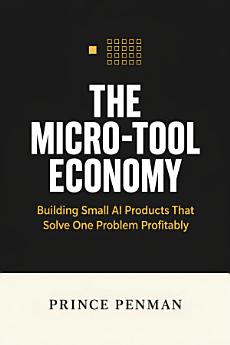
The Micro-Tool Economy: Building Small AI Products That Solve One Problem Profitably
About this ebook
You shipped something polished, told the internet about it, and watched a flat line where the signups should have been.
Most builders assume they have a skill problem. They learn another framework, follow the latest distribution advice, and try again—only to end up in the same place. The problem is rarely skill. It is selection. And selection has become harder precisely because building software has become dramatically cheaper.
The Micro-Tool Economy explores the part of software entrepreneurship no tool can automate: deciding what to build, who will pay for it, how much to charge, and how to keep it valuable.
The thesis is simple: When software becomes cheap to build, the smallest viable business becomes one of the most rational opportunities to pursue. A focused tool that solves one recurring, expensive problem for a clearly defined group of buyers can be built in weeks, priced according to its value, embedded in daily workflows, and operated profitably by one person.
The secret is doing less—and doing it deliberately.
This book introduces the one-problem constraint, a practical system for building sustainable, independent software businesses.
Inside, you'll learn how to:
Select the right problem using frequency, cost, and workflow position to evaluate opportunities objectively.
Discover hidden demand by finding shadow processes: spreadsheets, manual workarounds, and recurring frustrations people have learned to accept.
Validate before building with meaningful demand tests and clear criteria for abandoning weak ideas.
Control scope using the refusal list, the and test, and the discipline to ship less.
Build independently by making smarter technical decisions, using AI as an accelerant rather than a strategy, and planning for maintenance.
Price for value instead of competing on subscription fees, including how to raise prices without unnecessarily losing customers.
Improve retention by embedding your tool into customers' workflows, data, and collaborative habits.
Run a sustainable business using five essential metrics, a practical operating rhythm, and support conversations that reveal opportunities.
Choose when to expand through deepening, widening, or stacking.
Plan for the long game by knowing when to hold, sell, or sunset a product.
Who is this book for?
Solo founders, indie hackers, developers, consultants, and industry experts who want to build profitable software without outside funding, a large team, or an ambition to scale endlessly. It's for people who suspect conventional startup advice was written for someone else—because it was.
What this book isn't: A coding manual, a list of guaranteed ideas, or a get-rich-quick scheme. Its tool-agnostic principles are designed to remain useful long after today's technology stack changes.
You won't finish with a business handed to you. You'll finish with a way to recognize expensive, recurring problems in any industry, judge whether they're worth solving, and build a focused product without letting it consume your life.
A tool serving a hundred loyal customers at a healthy margin can be a success. So can a much larger business. What doesn't count is growing revenue while shrinking the life you're trying to improve.
Find one expensive problem. Make it disappear. Build a business around the value you create—and make sure the life it pays for is the one you actually wanted.