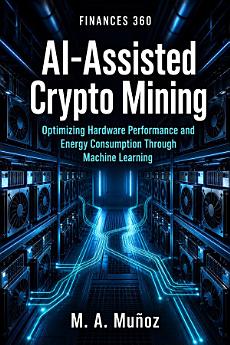
AI-Assisted Crypto Mining: Optimizing Hardware Performance and Energy Consumption Through Machine Learning
About this ebook
This book explains how these optimization systems actually work: from the Bayesian algorithms that discover the optimal voltage-frequency curve for each individual chip, to the thermal prediction models that anticipate hardware failures weeks before they occur, to the dynamic hash rate allocation engines that evaluate in real time which pool maximizes expected yield under current conditions. The reader will learn how to build and deploy these tools in Python, with reproducible code and reference architectures applicable to both a home setup and an industrial-scale farm.
The book also covers intelligent energy management: tariff arbitrage, renewable integration, participation in demand response programs, and financial models that treat electricity as a manageable asset rather than a fixed cost. The closing chapters present probabilistic profitability calculators that replace static estimates with outcome distributions, and an investment framework that evaluates mining as an asset class based on its level of technological readiness.
It is aimed at mining farm operators, hardware engineers, quantitative analysts, and digital asset investors who need to make decisions based on real data. No prior knowledge of machine learning is required. What is required is the willingness to manage mining for what it is today: a precision engineering business where competitive advantage belongs to those who program their machines best.
Finances 360 - Ed. 2026 | Miguel A. Muñoz
───────────────────