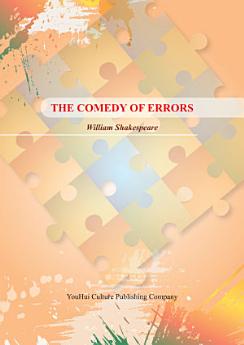
THE COMEDY OF ERRORS

· YouHui Culture Publishing Company
Ebook
64
Pages

About this ebook

1593

THE COMEDY OF ERRORS

by William Shakespeare

DRAMATIS PERSONAE

SOLINUS, Duke of Ephesus

AEGEON, a merchant of Syracuse

ANTIPHOLUS OF EPHESUS twin brothers and sons to

ANTIPHOLUS OF SYRACUSE Aegion and Aemelia

DROMIO OF EPHESUS twin brothers, and attendants on

DROMIO OF SYRACUSE the two Antipholuses

BALTHAZAR, a merchant

ANGELO, a goldsmith

FIRST MERCHANT, friend to Antipholus of Syracuse

SECOND MERCHANT, to whom Angelo is a debtor

PINCH, a schoolmaster

AEMILIA, wife to AEgeon; an abbess at Ephesus

ADRIANA, wife to Antipholus of Ephesus

LUCIANA, her sister

LUCE, servant to Adriana

A COURTEZAN

Gaoler, Officers, Attendants

SCENE:

Ephesus

THE COMEDY OF ERRORS

ACT I. SCENE 1

A hall in the DUKE'S palace

Enter the DUKE OF EPHESUS, AEGEON, the Merchant

of Syracuse, GAOLER, OFFICERS, and other ATTENDANTS

AEGEON. Proceed, Solinus, to procure my fall,

And by the doom of death end woes and all.

DUKE. Merchant of Syracuse, plead no more;

I am not partial to infringe our laws.

The enmity and discord which of late

Sprung from the rancorous outrage of your duke

To merchants, our well-dealing countrymen,

Who, wanting guilders to redeem their lives,

Have seal'd his rigorous statutes with their bloods,

Excludes all pity from our threat'ning looks.

For, since the mortal and intestine jars

'Twixt thy seditious countrymen and us,

It hath in solemn synods been decreed,

Both by the Syracusians and ourselves,

To admit no traffic to our adverse towns;

Nay, more: if any born at Ephesus

Be seen at any Syracusian marts and fairs;

Again, if any Syracusian born

Come to the bay of Ephesus-he dies,

His goods confiscate to the Duke's dispose,

Unless a thousand marks be levied,

To quit the penalty and to ransom him.

Thy substance, valued at the highest rate,

Cannot amount unto a hundred marks;

Therefore by law thou art condemn'd to die.
1593 THE COMEDY OF ERRORS by William Shakespeare DRAMATIS PERSONAE SOLINUS, Duke of Ephesus AEGEON, a merchant of Syracuse ANTIPHOLUS OF EPHESUS twin brothers and sons to ANTIPHOLUS OF SYRACUSE Aegion and Aemelia DROMIO OF EPHESUS twin brothers, and attendants on DROMIO OF SYRACUSE the two Antiph...

Discover more

About the author

William Shakespeare, 1564 - 1616 Although there are many myths and mysteries surrounding William Shakespeare, a great deal is actually known about his life. He was born in Stratford-Upon-Avon, son of John Shakespeare, a prosperous merchant and local politician and Mary Arden, who had the wealth to send their oldest son to Stratford Grammar School. At 18, Shakespeare married Anne Hathaway, the 27-year-old daughter of a local farmer, and they had their first daughter six months later. He probably developed an interest in theatre by watching plays performed by traveling players in Stratford while still in his youth. Some time before 1592, he left his family to take up residence in London, where he began acting and writing plays and poetry. By 1594 Shakespeare had become a member and part owner of an acting company called The Lord Chamberlain's Men, where he soon became the company's principal playwright. His plays enjoyed great popularity and high critical acclaim in the newly built Globe Theatre. It was through his popularity that the troupe gained the attention of the new king, James I, who appointed them the King's Players in 1603. Before retiring to Stratford in 1613, after the Globe burned down, he wrote more than three dozen plays (that we are sure of) and more than 150 sonnets. He was celebrated by Ben Jonson, one of the leading playwrights of the day, as a writer who would be "not for an age, but for all time," a prediction that has proved to be true. Today, Shakespeare towers over all other English writers and has few rivals in any language. His genius and creativity continue to astound scholars, and his plays continue to delight audiences. Many have served as the basis for operas, ballets, musical compositions, and films. While Jonson and other writers labored over their plays, Shakespeare seems to have had the ability to turn out work of exceptionally high caliber at an amazing speed. At the height of his career, he wrote an average of two plays a year as well as dozens of poems, songs, and possibly even verses for tombstones and heraldic shields, all while he continued to act in the plays performed by the Lord Chamberlain's Men. This staggering output is even more impressive when one considers its variety. Except for the English history plays, he never wrote the same kind of play twice. He seems to have had a good deal of fun in trying his hand at every kind of play. Shakespeare wrote 154 sonnets, all published on 1609, most of which were dedicated to his patron Henry Wriothsley, The Earl of Southhampton. He also wrote 13 comedies, 13 histories, 6 tragedies, and 4 tragecomedies. He died at Stratford-upon-Avon April 23, 1616, and was buried two days later on the grounds of Holy Trinity Church in Stratford. His cause of death was unknown, but it is surmised that he knew he was dying.
William Shakespeare, 1564 - 1616 Although there are many myths and mysteries surrounding William Shakespeare, a great deal is actually known about his life. He was born in Stratford-Upon-Avon, son of John Shakespeare, a prosperous merchant and local politician and Mary Arden, who had the wealth t...

Rate this ebook

Tell us what you think.

Reading information

Smartphones and tablets
Install the Google Play Books app for Android and iPad/iPhone. It syncs automatically with your account and allows you to read online or offline wherever you are.
Laptops and computers
You can listen to audiobooks purchased on Google Play using your computer's web browser.
eReaders and other devices
To read on e-ink devices like Kobo eReaders, you'll need to download a file and transfer it to your device. Follow the detailed Help Center instructions to transfer the files to supported eReaders.