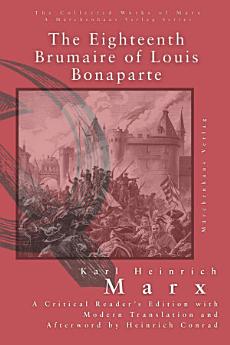
The Eighteenth Brumaire of Louis Bonaparte: A New Reader's Edition

· The Collected Works of Marx Book 18 · Märchen Press
Ebook
131
Pages
Eligible

About this ebook

Written in late 1851 and early 1852 and published in New York in 1852 in the journal Die Revolution, The Eighteenth Brumaire of Louis Bonaparte is Marx's searing analysis of the 1851 coup d'état in which Louis Napoléon Bonaparte seized dictatorial power in France. The title evokes Napoleon Bonaparte's original coup on the same date in the revolutionary calendar, drawing a historical parallel that Marx wields with bitter irony: what had once been world historical tragedy returns as farcical repetition. The essay is at once a forensic dissection of France's failed Second Republic and a methodological breakthrough, as Marx shifts from abstract theory to a concrete analysis of class forces, political institutions, and ideological masks. It is here that he first fully deploys his materialist conception of history not as a general theory, but as a relation explanatory method grounded in political contingency.

The text moves between caustic satire and analytical precision, portraying Louis Bonaparte as a political nonentity who embodies the contradictions of a fragmented bourgeois order. His rise is explained not by his strength, but by the decomposition of class alliances, the paralysis of parliamentary liberalism, and the mystification of political representation itself. In laying bare how the peasantry, petty bourgeoisie, and lumpenproletariat could be mobilized behind a hollow symbol of authority, Marx introduces a dark metaphysics of politics, in which ideology operates not merely as illusion but as real abstraction constituting social reality by concealing its origins. The work's structure rich in irony, recursive in its account, and dialectical in its logic makes it one of Marx's most literary and philosophically loaded texts, where the grotesque theatricality of modern power becomes both symptom and outcome of deeper historical contradictions.

For The Eighteenth Brumaire of Louis Bonaparte, to provide historical and intellectual context, the edition includes an afterword tracing Marx's intellectual relationships with revolutionary thinkers and philosophers (including Hegel, Feuerbach, Engels, and Ricardo), containing research into his ideological development and economic metaphysical theories, a complete timeline of his life and works, a glossary of Marxist terminology, and a detailed index of all of Marx's writings. For The Eighteenth Brumaire of Louis Bonaparte, Marx's difficult dialectical prose is recast in readable modern English while retaining the substance and force of the text. In this edition, The Eighteenth Brumaire of Louis Bonaparte is framed by material on Marx's intellectual development and the broader political, economic, religious, and philosophical consequences of his work.


Written in late 1851 and early 1852 and published in New York in 1852 in the journal Die Revolution, The Eighteenth Brumaire of Louis Bonaparte is Marx's searing analysis of the 1851 coup d'état in which Louis Napoléon Bonaparte seized dictatorial power in France. The title evokes Napoleon Bonapa...

Discover more

About the author

Karl Marx (1818 to 1883) was a German philosopher, economist and revolutionary whose ideas have had a deep influence on political theory, economics and social science. Along with Friedrich Engels, Marx developed the theory of historical materialism, arguing that economic structures fundamentally shape social development. His seminal works, The Communist Manifesto and Das Kapital, criticise the capitalist system, arguing that it leads to class struggle and the exploitation of the working class. Marx envisioned a society in which class distinctions would dissolve, culminating in a classless, stateless society. His theories laid the foundations for several socialist and communist movements, influencing world politics and inspiring revolutions. Although controversial, Marx's analysis of capitalism and advocacy of social justice continue to be studied and debated, making him one of the most influential thinkers in modern history.
Karl Marx (1818 to 1883) was a German philosopher, economist and revolutionary whose ideas have had a deep influence on political theory, economics and social science. Along with Friedrich Engels, Marx developed the theory of historical materialism, arguing that economic structures fundamentally ...

Rate this ebook

Tell us what you think.

Reading information

Smartphones and tablets
Install the Google Play Books app for Android and iPad/iPhone. It syncs automatically with your account and allows you to read online or offline wherever you are.
Laptops and computers
You can listen to audiobooks purchased on Google Play using your computer's web browser.
eReaders and other devices
To read on e-ink devices like Kobo eReaders, you'll need to download a file and transfer it to your device. Follow the detailed Help Center instructions to transfer the files to supported eReaders.