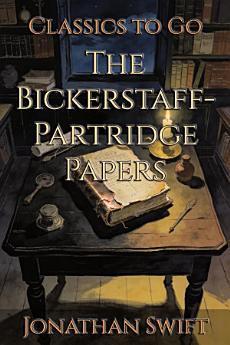
The Bickerstaff-Partridge Papers: Restored Classics to Go Edition

· Otbebookpublishing
Ebook
54
Pages
Eligible

About this ebook

Jonathan Swift's "Bickerstaff-Partridge" satire begins with Isaac Bickerstaff's mock-serious assault on almanack-makers, especially John Partridge, whose astrology is exposed as a jumble of vague predictions, grammatical blunders, and self-serving nonsense. With deadpan confidence, Bickerstaff presents himself as a truer prophet, ridiculing the public's hunger for certainty while turning prophecy into a comic weapon against politics, superstition, and easy credulity. The satire escalates into a calendar of outrageous forecasts for Europe, war, and royal deaths, all delivered with absurd precision and grand historical sweep. Swift then stages the supposed death of Partridge, followed by a mock elegy and epitaph that reduce him to a "Cobler, Starmonger, and Quack." Yet the joke deepens when Partridge himself protests, insisting on his innocence and defending his reputation. In a series of comic scenes, he is haunted by rumors of his burial, besieged by mourners and tradesmen, and forced to watch his wife and livelihood suffer as print fiction overtakes reality. Sharp, mischievous, and brilliantly theatrical, the work skewers false authority, public gullibility, and the business of manufactured fame. This edition has been fully restored with modern typesetting, custom cover design.
Jonathan Swift's "Bickerstaff-Partridge" satire begins with Isaac Bickerstaff's mock-serious assault on almanack-makers, especially John Partridge, whose astrology is exposed as a jumble of vague predictions, grammatical blunders, and self-serving nonsense. With deadpan confidence, Bickerstaff pr...

Discover more

About the author

Jonathan Swift was born in Dublin in 1667 and grew up between Ireland and England, a life shaped by political tension, religious division, and a sharp awareness of power's abuses. Educated at Trinity College, Dublin, he went on to serve as a churchman, satirist, and public commentator, moving in influential literary and political circles while remaining deeply skeptical of human vanity and institutional hypocrisy. Over the course of his career, he became one of the great masters of English prose, admired for his wit, precision, and fearless use of satire to expose corruption, folly, and self-deception. His writing ranges from biting political pamphlets to imaginative allegory and comic pseudo-reportage, and his work helped define satire as a force for moral criticism as much as entertainment. Swift's central concerns—power, ambition, inequality, colonialism, religious conflict, and the fragility of reason—still feel urgently modern, which is why his voice continues to resonate in an age of misinformation and public spectacle. He remains significant not only for his brilliance as a stylist, but for his ability to make readers laugh while forcing them to confront uncomfortable truths about society and themselves. Readers who enjoy sharp satire, political wit, and literature that is both entertaining and intellectually provocative will find Swift especially rewarding.
Jonathan Swift was born in Dublin in 1667 and grew up between Ireland and England, a life shaped by political tension, religious division, and a sharp awareness of power's abuses. Educated at Trinity College, Dublin, he went on to serve as a churchman, satirist, and public commentator, moving in ...

Rate this ebook

Tell us what you think.

Reading information

Smartphones and tablets
Install the Google Play Books app for Android and iPad/iPhone. It syncs automatically with your account and allows you to read online or offline wherever you are.
Laptops and computers
You can listen to audiobooks purchased on Google Play using your computer's web browser.
eReaders and other devices
To read on e-ink devices like Kobo eReaders, you'll need to download a file and transfer it to your device. Follow the detailed Help Center instructions to transfer the files to supported eReaders.