About this ebook
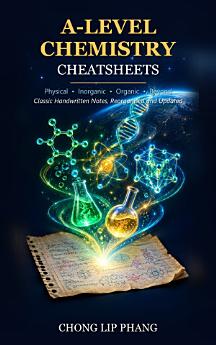
A-Level Chemistry Cheatsheets began as a folder of handwritten notes written in 2000: the definitions, equations, reaction conditions, colours, mechanisms and worked examples that the author found most worth remembering. Every page has now been transcribed, checked, corrected and reorganised, the hand sketches have been redrawn as clean diagrams and structural formulae, and the content has been brought up to date with today's syllabuses. The result is a compact 8.5 x 11 inch revision book of 17 chapters in two parts, built for the night before an examination and for anyone who wants to refresh a topic quickly.
This is a cheatsheet, not a textbook. It assumes you have met each topic before, and it helps you remember, connect and apply what you know, with reaction tables instead of paragraphs and boxed answers instead of long explanations.
What is inside
Part I, A-Level Chemistry: electron configuration, ionisation energies and mass spectrometry; moles and redox equations; bonding, shapes of molecules and intermolecular forces; enthalpy changes, Born-Haber cycles, entropy and Gibbs free energy; rate equations and the Arrhenius equation; Kc, Kp, pH, buffers, Ksp and partition coefficients; electrode potentials, the Nernst equation, electrolysis, batteries and fuel cells; Period 3, Group 2 and the halogens; nitrogen, sulfur and air pollution; transition elements and complexes; organic naming, isomerism, mechanisms and synthesis; crude oil, chromatography, and infrared and NMR spectroscopy.
Part II, Beyond A-Level Chemistry: the discovery of the gases of the air, the structure of the atmosphere and the Antarctic ozone hole, the water, carbon and nitrogen cycles, the cell and the lac operon, and the origin of life and life as a complex system, with ten quizzes.
Appendices: a syllabus map that places every Part I section in Cambridge International AS & A Level Chemistry 9701 (2025-2027 syllabus, with a note on the 2028-2030 syllabus) and Pearson Edexcel A Level Chemistry 9CH0, and a periodic table with the key constants and data.
Why this book is different
- Reaction tables give reagents, conditions, products and observations at a glance: Period 3 oxides and chlorides, tests for halide ions, transition-metal colours and ligand exchange, and the reactions of the main organic functional groups.
- Worked examples with every answer checked: Kp and Ksp calculations, pH and buffers, Hess and Born-Haber cycles, cell potentials and the Nernst equation, and gas-volume problems.
- Equations balanced and data values checked against standard data-book values, with "Common mistake" and "Tip" notes that show where marks are lost.
- Clean diagrams throughout: shapes of molecules, energy profiles and the Boltzmann distribution, titration curves, electrochemical cells, d-orbital splitting, curly-arrow mechanisms and an organic reaction map.
- Update notes mark what the current syllabuses require, where Cambridge and Edexcel differ, and what has changed since the notes were written, from lithium-ion cells and electric cars to the recovery of the ozone layer.
This book is an independent revision aid. It is not endorsed by, or affiliated with, Cambridge University Press & Assessment or Pearson Edexcel. Always check the current specification of your own examination board.
Discover more
Ratings and reviews
About the author
Chong Lip Phang is a seasoned web and mobile app developer in Malaysia who has been writing computing books since 2013. He created the mobile game Quiz Jungle, which features multiplayer quiz games on various subjects, and he wrote the original notes behind this book in 2000. His book Mastering Front-End Web Development has won seven awards from BookAuthority.