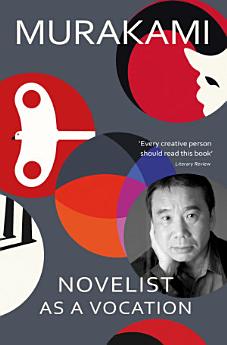
Novelist as a Vocation: An exploration of a writer’s life from the Sunday Times bestselling author of Norwegian Wood
About this ebook
'You end this collection...vowing to never let life, or writing, get so complicated again' Guardian
Readers who have long wondered where the mysterious novelist gets his ideas and what inspires his beautifully surreal worlds will be fascinated by this highly personal look at the craft of writing.
In this engaging book, the internationally best-selling author shares with readers what he thinks about being a novelist; his own origins as a writer; and his musings on the sparks of creativity that inspire other writers, artists, and musicians.
'Murakami is like a magician who explains what he's doing as he performs the trick and still makes you believe he has supernatural powers' New York Times Book Review
'A fascinating glimpse of the peculiar writerly life' Sunday Times
** A TIMES, SUNDAY TIMES and NEW STATESMAN BOOK OF THE YEAR**
Discover more
Ratings and reviews
About the author
Haruki Murakami (Author)
In 1978, Haruki Murakami was twenty-nine and running a jazz bar in downtown Tokyo. One April day, the impulse to write a novel came to him suddenly while watching a baseball game. That first novel, Hear the Wind Sing, won a new writers' award and was published the following year. More followed, including A Wild Sheep Chase and Hard-Boiled Wonderland and the End of the World, but it was Norwegian Wood, published in 1987, that turned Murakami from a writer into a phenomenon.
In works such as The Wind-Up Bird Chronicle, 1Q84, What I Talk About When I Talk About Running, First Person Singular and The City and Its Uncertain Walls Murakami's distinctive blend of the mysterious and the everyday, of melancholy and humour, continues to enchant readers, ensuring his place as one of the world's most acclaimed and well-loved writers.
Philip Gabriel (Translator)
Philip Gabriel is the author of Mad Wives and Island Dreams: Shimao Toshio and the Margins of Japanese Literature and Spirit Matters: The Transcendent in Modern Japanese Literature and has translated many novels and short stories by Haruki Murakami and other modern writers. He is recipient of the Japan-U.S. Friendship Commission Prize for the Translation of Japanese Literature (2001) for his translation of Senji Kuroi’s Life in the Cul-de-Sac, and the 2006 PEN/Book-of-the-Month Club Translation Prize for his translation of Murakami's Kafka on the Shore.
Ted Goossen (Translator)
Theodore (Ted) Goossen has translated the work
of many Japanese writers, most notably Naoya
Shiga, Haruki Murakami, and Hiromi Kawakami.
He is the editor of The Oxford Book of Japanese
Short Stories (1997) and the co-editor and founder, with Motoyuki Shibata, of the annual
literary journal Monkey Business (now Monkey:
new writing from Japan), which, since 2011, has
introduced a new generation of Japanese writers to English-speaking readers. Essays and stories by, as well as interviews with, Murakami are a staple of every issue.