About this ebook
A friend in Petersburg has written that he is free; the order has not come. He lies under a willow in the fort's garden and writes down his dreams. He pities the soldiers — "the poorest, the most wretched estate in our Orthodox fatherland" — and rails at their officers. On 21 July the official news of his release comes, and in August he sails into Astrakhan in "the frailest of fishing barks".
There, from 15 to 22 August, his countrymen celebrate his freedom with a holiday, and take the diary out of his hands: they "deprived me of the freedom to keep my journal myself and took this duty upon themselves". Then up the Volga on the steamer Knyaz Pozharsky, to Nizhny Novgorod, where a paper forbids him both capitals and leaves him under the secret surveillance of the police: "Fine freedom. A dog on a leash." He waits there nearly six months. He draws portraits and the old churches of the town, goes to the theatre, writes poems, and on his name day a letter tells him he may live in Petersburg. On 27 March 1858 "the thunder-bearing locomotive whistled and stopped in Petersburg" — old friends, the Hermitage, and a call on the chief of gendarmes.
He writes a line one day and pages the next. And one day he signs a letter "Artist T. Shevchenko": "For 10 years I have styled myself and signed myself 'Private T. Shevchenko'."
The diary, he wrote, had become "as necessary to me as a doctor to the sick".
The man who wrote it
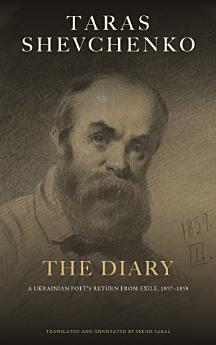
Taras Shevchenko (1814–1861), the poet of Kobzar, was born a serf and bought out of serfdom at twenty-four, with the money raised by a lottery for a portrait painted by Karl Bryullov. In 1847 he was arrested as a member of the Cyril and Methodius Brotherhood and sent to the Orenburg Corps as a private soldier, under an order that he was not to write and not to draw. He kept this diary in Russian, and it was first printed, with cuts, in the Petersburg journal Osnova in 1861 and 1862, after his death.
What is in this edition
· The whole diary, every entry from 12 June 1857 to 13 July 1858, in a new English translation from the Russian
· An introduction, a list of the people of the book, a note on pronunciation, notes on the edition and the translation, and a chronology of Shevchenko's life
· 970 notes at the foot of the page — who the people are, and the words, songs and places
· 45 essays at the back, following the diary in order, for after you have finished
Translated from the Russian text of the six-volume collected works of Shevchenko, Kyiv, 2003, which a note at the front of the book describes.
Discover more
Ratings and reviews
About the author
Taras Shevchenko was born a serf in 1814 and was twenty-four before he was a free man. His freedom was bought in 1838 with the money raised by a lottery for a portrait painted by Karl Bryullov, and he went into the Academy of Arts in Petersburg as a student of painting. Two years after he was freed he published Kobzar, his first book of poems.
On 5 April 1847 he was arrested at the Dnipro crossing by Kyiv as a member of the Cyril and Methodius Brotherhood, and was sent to the Separate Orenburg Corps as a private soldier, under an order that he was not to write and not to draw. He served at the Orsk fortress, crossed the steppe with the Aral survey expedition, and from October 1850 was held at Novopetrovsk Fort on the Caspian, where he remained nearly seven years. He wrote nine novellas in Russian in the years of his exile.
He began this diary there in June 1857, while he waited for his release, and kept it on the road home: down to Astrakhan, up the Volga, through nearly six months held at Nizhny Novgorod, and on to Petersburg, which he reached in March 1858. He gave the diary to his friend M. M. Lazarevsky that July.
He died at Petersburg in 1861, aged forty-seven, and was buried, as he had asked, on a hill near Kaniv. The diary was first printed in the two years after his death, in the Petersburg journal Osnova, with cuts made for the censorship.
Serhii Sakal was born in Ukraine in 1987 and lives in the United States. He read the Ukrainian classics at school, as everyone there does, and came back to them as an adult in a country where they had not been read. His previous translations are Taras Shevchenko’s The Artist, The Twins and The Hired Girl and Varnak, Lesya Ukrainka’s The Forest Song and The Boyar’s Wife and In the Catacombs, Osyp Turiansky’s Beyond the Limits of Pain and The Thought of the Primeval Forest, Volodymyr Vynnychenko’s Notes of a Snub-Nosed Mephistopheles, Andrii Chaikovsky’s After His Sister, Ivan Franko’s For the Hearth, Oleksa Slisarenko’s The Black Angel, Yevhen Hrebinka’s Aleksei Chaikovsky and Panteleimon Kulish’s The Black Council.
He translated this one because, after three books of Shevchenko’s novellas in this series, it is the first in which Shevchenko speaks as himself, and because a diary begun by a soldier forbidden to write and to draw deserves to be read in English.