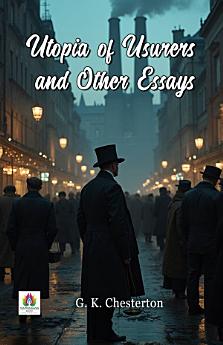
Utopia of Usurers and other Essays
About this ebook
In the opening essay, Chesterton unpacks the concept of a ‘utopia of usurers’, illustrating that a society fixated on wealth accumulation often compromises the values that lead to true happiness and fulfillment. The paradox lies in the idea that the very forces that promise prosperity can strip away the human soul, leaving individuals isolated and emotionally impoverished. Chesterton challenges us to examine the ethical implications of our economic choices and urges readers to seek a balance between personal ambition and the communal good, pushing back against the tide of unbridled capitalism.
Chesterton’s essays also explore broader themes such as individualism versus collectivism, as he lays bare the flawed notion that economic progress equates to social advancement. His perspective is enriched by a historical context that demands we reconsider our understanding of wealth distribution and its impact on societal structures. Each essay serves as a lens through which readers can scrutinize the complexities of modern life, encouraging a critical reassessment of the values that govern our existence. With a flair for the absurd and a knack for highlighting the contradictions of contemporary society, Chesterton layers humor with profound insights.
Throughout this collection, Chesterton remains firmly rooted in his beliefs, adeptly blending moral philosophy with literary analysis. His articulate exposition of the challenges facing humanity today prompts readers to reflect on human nature and the repercussions of abandoning tradition and faith. In effect, the essays act as a clarion call against the encroachment of an impersonal economic landscape that often overlooks the nuances of human experience.
In the face of increasing materialism, Chesterton’s writings emerge as a fresh perspective that highlights the importance of preserving tradition and ethical consideration in politics and economics. As he champions the cause of social justice, he passionately defends the idea that economic systems should enhance the human experience rather than threaten it. Utopia of Usurers and Other Essays excels in its capacity to provoke thought, challenge complacency, and ignite meaningful discourse around the pressing issues of our time, and by doing so, Chesterton cements his position as one of the most insightful social commentators of his era. His unique ability to interweave humor with serious critique invites readers to engage with his ideas fully, leaving them pondering the complexities of social structures and the moral imperatives that ought to guide them.
This collection is not merely a critique of modern economics; it stands as a testament to Chesterton's belief in the power of ideas and the importance of fostering a society that values compassion, justice, and the innate worth of every individual. Readers are invited to delve into this treasury of essays that prompt an exploration of what it means to create a true utopia—a place where humanity flourishes amid a system designed for the benefit of all rather than the privilege of a few.