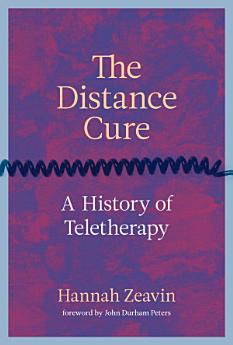
The Distance Cure: A History of Teletherapy
Aug 2021 · MIT Press
Ebook
328
Pages
Tools
info
family_home
Eligible
info
About this ebook
Psychotherapy across distance and time, from Freud’s treatments by mail to crisis hotlines, radio call-ins, chatbots, and Zoom sessions.
Therapy has long understood itself as taking place in a room, with two (or more) people engaged in person-to-person conversation. And yet, starting with Freud’s treatments by mail, psychotherapy has operated through multiple communication technologies and media. These have included advice columns, radio broadcasts, crisis hotlines, video, personal computers, and mobile phones; the therapists (broadly defined) can be professional or untrained, strangers or chatbots. In The Distance Cure, Hannah Zeavin proposes a reconfiguration of the traditional therapeutic dyad of therapist and patient as a triad: therapist, patient, and communication technology.
Zeavin tracks the history of teletherapy (understood as a therapeutic interaction over distance) and its metamorphosis from a model of cure to one of contingent help. She describes its initial use in ongoing care, its role in crisis intervention and symptom management, and our pandemic-mandated reliance on regular Zoom sessions. Her account of the “distanced intimacy” of the therapeutic relationship offers a powerful rejoinder to the notion that contact across distance (or screens) is always less useful, or useless, to the person seeking therapeutic treatment or connection. At the same time, these modes of care can quickly become a backdoor for surveillance and disrupt ethical standards important to the therapeutic relationship. The history of the conventional therapeutic scenario cannot be told in isolation from its shadow form, teletherapy. Therapy, Zeavin tells us, was never just a “talking cure”; it has always been a communication cure.
Psychotherapy across distance and time, from Freud’s treatments by mail to crisis hotlines, radio call-ins, chatbots, and Zoom sessions.
Therapy has long understood itself as taking place in a room, with two (or more) people engaged in person-to-person conversation. And yet, starting with Freud’...
About the author
Hannah Zeavin is a Lecturer in the Departments of English and History at the University of California, Berkeley, and is affiliated with the University of California, Berkeley, Center for Science, Technology, Medicine, and Society. She is a Visiting Fellow at Columbia University’s Center for Social Difference and Editorial Associate at The Journal of the American Psychoanalytic Association. Her work has appeared or is forthcoming in American Imago, differences: A Journal of Feminist Cultural Studies, the Los Angeles Review of Books, Real Life Magazine, Slate, and elsewhere.
Hannah Zeavin is a Lecturer in the Departments of English and History at the University of California, Berkeley, and is affiliated with the University of California, Berkeley, Center for Science, Technology, Medicine, and Society. She is a Visiting Fellow at Columbia University’s Center for Socia...
Rate this ebook
Tell us what you think.
Reading information
Smartphones and tablets
Install the Google Play Books app for Android and iPad/iPhone. It syncs automatically with your account and allows you to read online or offline wherever you are.
Laptops and computers
You can listen to audiobooks purchased on Google Play using your computer's web browser.
eReaders and other devices
To read on e-ink devices like Kobo eReaders, you'll need to download a file and transfer it to your device. Follow the detailed Help Center instructions to transfer the files to supported eReaders.