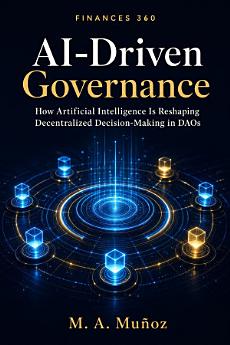
AI-Driven Governance: How Artificial Intelligence Is Reshaping Decentralized Decision-Making in DAOs
M. Muñoz
M. Muñoz
Ebook
152
Pages
Tools
info
family_home
Eligible
info
About this ebook
Decentralized Autonomous Organizations represent one of the most significant organizational innovations of the digital age, yet they face persistent challenges in governance efficiency, voter participation, and resistance to manipulation. This book examines how artificial intelligence is being integrated into DAO governance frameworks to address these structural weaknesses without compromising the decentralization principles that define them. Readers will explore the technical foundations of AI-assisted proposal analysis, automated risk scoring, and predictive modeling for community outcomes. The author presents real-world case studies drawn from major DAO ecosystems, illustrating both successful implementations and cautionary failures. The book also addresses the philosophical tensions that arise when algorithmic systems influence collective human decisions, raising important questions about accountability, transparency, and the concentration of power in smart contract logic. Whether the reader is a blockchain developer, a governance researcher, a token holder seeking to participate more effectively, or a policy analyst tracking the evolution of decentralized institutions, this work provides the analytical tools and conceptual frameworks needed to understand where AI and DAO governance intersect today and where they are headed in the near future.
───────────────────
Decentralized Autonomous Organizations represent one of the most significant organizational innovations of the digital age, yet they face persistent challenges in governance efficiency, voter participation, and resistance to manipulation. This book examines how artificial intelligence is being in...
Discover more
Rate this ebook
Tell us what you think.
Reading information
Smartphones and tablets
Install the Google Play Books app for Android and iPad/iPhone. It syncs automatically with your account and allows you to read online or offline wherever you are.
Laptops and computers
You can listen to audiobooks purchased on Google Play using your computer's web browser.
eReaders and other devices
To read on e-ink devices like Kobo eReaders, you'll need to download a file and transfer it to your device. Follow the detailed Help Center instructions to transfer the files to supported eReaders.