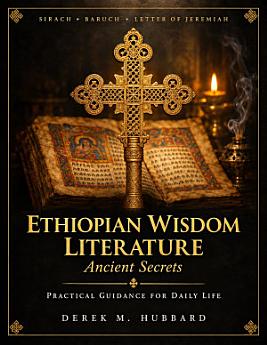
If you have ever wished that an old, wise teacher would sit down with you and tell you how to handle your money, your temper, your friends, your family, your health and your grief, then Ethiopian Wisdom Literature: Ancient Secrets — Sirach, Baruch, Letter of Jeremiah: Practical Guidance for Daily Life is the book you have been waiting for, because Derek M. Hubbard takes three ancient writings that most people in Britain have never read—the Wisdom of Jesus ben Sira, usually called Sirach or Ecclesiasticus; the Book of Baruch; and the short, sharp Letter of Jeremiah—and opens them up in clear, modern English, showing how they speak directly to the questions every adult asks sooner or later, from how to keep your temper when someone treats you unfairly, to whom you can really trust, to how to care for an ageing parent whose mind is going, to whether you should lend money to your brother or sign for his loan, to how to grieve without being swallowed by grief, to what to do when your own bad choices have landed you in a mess, to how to stop giving your life to things that cannot love you back, and the book begins by introducing you to the remarkable Christian tradition that has kept these books close for more than fifteen hundred years, the Ethiopian Orthodox Tewahedo Church, whose Bible is larger and older in its shape than almost any other in the world, and which preserved whole books that survive complete nowhere else, such as 1 Enoch and Jubilees, and which also kept alive a steady tradition of practical wisdom—proverbs, moral teaching, and books like Sirach that tell you how to speak, eat, work, grieve and forgive, and Hubbard, writing as a respectful guest in that tradition rather than its spokesman, explains how Christianity reached the kingdom of Aksum in the fourth century, how the Scriptures were translated into the ancient language of Ge'ez, and how the Ethiopian Church, unlike much of Western Christianity, simply kept reading these books while others argued over whether they belonged in the Bible at all, and then the book introduces you to the teachers themselves: Ben Sira, the sharp, warm, sometimes crusty old scribe who ran a school for young men in Jerusalem around 190 to 175 BC, whose grandson carried the book to Egypt and translated it into Greek, and whose Hebrew original was thought to be lost for well over a thousand years until Scottish twin sisters Agnes Smith Lewis and Margaret Dunlop Gibson bought a bundle of old manuscript leaves in Cairo in 1896 and showed one to Solomon Schechter, who recognised it as a page of Sirach in Hebrew and soon travelled to Cairo himself to bring back a vast hoard of fragments from the genizah of the Ben Ezra Synagogue, and then in 1964 the Israeli archaeologist Yigael Yadin excavated the fortress of Masada and found a scroll containing part of Sirach in Hebrew that had been copied before the fall of Masada, so that today roughly two- thirds of the Hebrew text has been recovered; and then the book introduces you to Baruch, the faithful secretary who wrote down the prophecies of Jeremiah and read them aloud to the people, and to Jeremiah himself, the weeping prophet who was beaten, put in the stocks, thrown into a muddy cistern and accused of treason, and who nevertheless wrote to the exiles in Babylon telling them to build houses, plant gardens, marry, have children and seek the welfare of the city where they had been sent, because in its welfare they would find their own; and then the book moves into its heart: a long, practical section on Sirach, taking it by theme rather than in strict order so that you can go straight to the chapter you need, with chapters on reverence and humility, on speech and silence, on friendship, on family and marriage, on money and work, on the body, food, sleep, doctors and grief, and on anger and forgiveness, and each chapter is anchored in the text itself, with verse references given so you can read them in your own Bible, and at the end of every chapter you will find a short section called Putting It Into Practice, because Ben Sira's whole point is that wisdom is something you do, not something you merely admire, and the book does not skip the passages that make modern readers wince, because Ben Sira was a man of his time, and on some subjects, particularly women and the discipline of children and servants, he says things that make a modern reader flinch, and Hubbard faces those passages honestly and suggests a simple rule: when a saying demeans or harms a group of people, set it aside as a product of its time; when a saying makes you uncomfortable because it challenges your own behaviour, stay with it, and then the book turns to Baruch, the book for when things have gone wrong, with its long, honest prayer of confession in which the exiles gather by the river Sud, weep, fast and pray, and then do something very practical, collecting money to send to Jerusalem to pay for offerings in the ruins of the temple, and the prayer refuses the three usual escape routes—it does not blame circumstances, it does not blame other people, and it does not even rest on the excuse that everyone was doing it—it simply says "we" and "each of us," and Hubbard shows how owning your mistakes sets you free, how to tell the difference between healthy guilt and crushing shame, how to say sorry well in five parts, and how to begin again, and then the book turns to the Letter of Jeremiah, the short, sharp, funniest writing in the book, which mocks the idols of Babylon with observations that each point to something useful—they are made, they are expensive to maintain, they need looking after, they cannot see, they are hollow and decaying, they cannot stand up, they cannot help—and which gives its most memorable image: like a scarecrow in a cucumber patch, which guards nothing, so are their gods of wood, overlaid with gold and silver, and Hubbard shows how this ancient letter helps you see through the idols of today—the screen, money and possessions, image and appearance, gambling and quick riches, work and achievement, other people—and offers five questions to test an idol: can it see me, can it speak to me, can it save me, who profits, and does it rule me by fear; and then the book brings everything home with a section on how Ethiopian Christians actually live out wisdom together, through fasting, the coffee ceremony and community, with chapters on the traditional coffee ceremony, with its three rounds called abol, tona and baraka, meaning blessing, and on community institutions like the equb savings circle, the iddir burial society, and the mahber fellowship, and on prayer with the body, and on welcoming the stranger, and then a chapter on growing older well and leaving a good name, with Ben Sira's teaching that rich experience is the crown of the old, and that a good name will outlast a thousand hoards of gold, and a final chapter giving you a thirty- day reading path through all three books, one short passage and one small action a day, with four prayers for the four weeks of the path, and guidance on walking the path as a group, and signs that the path is working, and how to choose a season for beginning; and at the end you will find a letter to you, answers to the questions readers ask most often, a short glossary of unfamiliar words like andemta, equb, Ge'ez, gursha, iddir, injera, jebena, mahber, Meskel, qene, tabot, Tewahedo, Timkat and tsom, and suggestions for further reading, and whether you are a curious reader who has heard about the Ethiopian Bible and wants to know what is really in it without being buried in footnotes, a person of faith, whether Orthodox, Catholic, Anglican, Protestant or simply searching, who wants to read these books devotionally, or a person who simply wants help with life, who may not be sure what you believe and that is fine, because Ben Sira was writing for young men in Jerusalem who needed to learn how to behave at a banquet, how to handle a boss and how to manage a household, and his advice travels remarkably well, this book will give you a steady, wise companion for the ordinary days, and will introduce you to an old teacher from Jerusalem, a scribe in exile and a prophet's letter to a frightened people who have been waiting a long time for someone to listen, and who still know you, and who still have something to say.Sirach 2:1–2 (author’s rendering): “My child, when you come to serve the Lord, prepare yourself for testing. Set your heart straight, hold firm, and do not panic when trouble comes.”
Who This Book Is For
Curious readers — who have heard about the Ethiopian Bible and want to know what is really in it.
People of faith — who want to read Sirach, Baruch and the Letter of Jeremiah devotionally.
Anyone seeking practical wisdom — on money, friendship, family, health, anger and forgiveness.
Bible study groups — with a ready-made thirty-day reading plan and discussion questions.
Ethiopian and Eritrean diaspora — who want to share their church's wisdom tradition in English.
Readers of the Apocrypha — who want a clear, trustworthy guide to these ancient books.