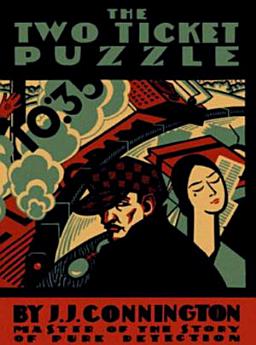
The Two Ticket Puzzle
Rare Treasure Editions
Ebook
184
pagine
Strumenti
info
family_home
Idoneo
info
Informazioni su questo ebook
A mean-spirited businessman Oswald Preston is discovered shot dead under the seat in an empty compartment of a railway carriage. While there seems to be several people who potentially bore him a grudge including his wife, his ward, a former employee and his wife's alleged lover a prominent local doctor. Yet it is almost impossible to see how anyone could have committed the murder while the train was in motion between two stations. Ross and his men set about a lengthy, painstaking task of checking all the train tickets of those passengers travelling on the train. Eventually, the work pays off and they are able to unmask the murderer and give chase as he attempts to escape.
A mean-spirited businessman Oswald Preston is discovered shot dead under the seat in an empty compartment of a railway carriage. While there seems to be several people who potentially bore him a grudge including his wife, his ward, a former employee and his wife's alleged lover a prominent local ...
Scopri di più
Informazioni sull'autore
Zamyatin studied at the Polytechnic Institute in St. Petersburg and became a professional naval engineer. His first story appeared in 1908, and he became serious about writing in 1913, when his short novel A Provincial Tale (1913) was favorably received. He became part of the neorealist group, which included Remizov and Prishvin. During World War I, he supervised the construction of icebreakers in England for the Russian government. After his return home, he published two satiric works about English life, "The Islanders" (1918) and "The Fisher of Men" (1922). During the civil war and the early 1920s, Zamyatin published theoretical essays as well as fiction. He played a central role in many cultural activities---as an editor, organizer, and teacher of literary technique---and had an important influence on younger writers, such as Olesha and Ivanov. Zamyatin's prose after the Revolution involved extensive use of ellipses, color symbolism, and elaborate chains of imagery. It is exemplified in such well-known stories as "Mamai" (1921) and "The Cage" (1922). His best-known work is the novel We (1924), a satiric, futuristic tale of a dystopia that was a plausible extrapolation from early twentieth-century social and political trends. The book, which directly influenced George Orwell's (see Vol. 1) 1984, 1984, was published abroad in several translations during the 1920s. In 1927 a shortened Russian version appeared in Prague, and the violent press campaign that followed led to Zamyatin's resignation from a writers' organization and, eventually, to his direct appeal to Stalin for permission to leave the Soviet Union. This being granted in 1931, Zamyatin settled in Paris, where he continued to work until his death. Until glasnost he was unpublished and virtually unknown in Russia.
Zamyatin studied at the Polytechnic Institute in St. Petersburg and became a professional naval engineer. His first story appeared in 1908, and he became serious about writing in 1913, when his short novel A Provincial Tale (1913) was favorably received. He became part of the neorealist group, wh...
Valuta questo ebook
Dicci cosa ne pensi.
Informazioni sulla lettura
Smartphone e tablet
Installa l'app Google Play Libri per Android e iPad/iPhone. L'app verrà sincronizzata automaticamente con il tuo account e potrai leggere libri online oppure offline ovunque tu sia.
Laptop e computer
Puoi ascoltare gli audiolibri acquistati su Google Play usando il browser web del tuo computer.
eReader e altri dispositivi
Per leggere su dispositivi e-ink come Kobo e eReader, dovrai scaricare un file e trasferirlo sul dispositivo. Segui le istruzioni dettagliate del Centro assistenza per trasferire i file sugli eReader supportati.