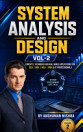
System analysis and design VOL-1
معلومات عن هذا الكتاب الإلكتروني
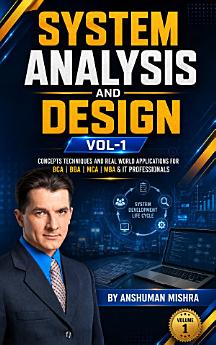
"System Analysis and Design: Concepts, Techniques, and Real-World Applications VOL-1"
For BCA, BBA, MCA, MBA, and IT Professionals
Table of Contents:
Unit I: Introduction to System Analysis and Design 1-36
1.1 What is System Analysis and Design?
1.2 Evolution and Importance of System Development
1.3 Types of Systems: Open, Closed, Deterministic, Probabilistic
1.4 Role of System Analyst in Business
1.5 System Development Life Cycle (SDLC) Overview
1.6 Participants in System Development
Unit II: System Development Life Cycle (SDLC) 37-76
2.1 Introduction to SDLC
2.2 SDLC Phases and Activities
2.3 Waterfall Model
2.4 Spiral Model
2.5 Iterative and Agile Models
2.6 Prototyping Model
2.7 Comparative Analysis of SDLC Models
Unit III: Feasibility Study and Project Initiation 77-129
3.1 Overview of Feasibility Study
3.2 Types of Feasibility: Technical, Economic, Operational, Legal, Schedule
3.3 Cost-Benefit Analysis
3.4 Preparing a Feasibility Report
3.5 Project Selection Criteria
3.6 Risk Analysis and Mitigation
Unit IV: Requirements Gathering and Analysis 130-172
4.1 Introduction to Requirement Analysis
4.2 Fact-Finding Techniques: Interviews, Questionnaires, Observation, Document Review
4.3 Functional vs. Non-Functional Requirements
4.4 Use Case Analysis
4.5 Requirement Specification Document (SRS)
4.6 Requirement Validation and Management
Unit V: System Design 173-243
5.1 Design Principles and Objectives
5.2 Logical vs. Physical Design
5.3 Input and Output Design
5.4 User Interface Design Guidelines
5.5 Database Design: ER Diagrams, Normalization
5.6 Data Dictionary and Metadata
5.7 Control and Security Design
About the Book: System Analysis and Design: Concepts, Techniques, and Real-World Applications VOL-1
Introduction
In an era where technological innovation drives competitive advantage and digital transformation reshapes businesses across industries, the role of system analysis and design (SAD) becomes increasingly critical. This book, titled "System Analysis and Design: Concepts, Techniques, and Real-World Applications," is crafted specifically for students of BCA, MCA, BBA, and MBA, as well as IT professionals and budding analysts who seek to master the principles, practices, and tools of modern system development.
The book adopts a balanced and integrative approach, blending theoretical foundations with real-life case studies, hands-on techniques, and emerging technologies. Each chapter is structured to ensure clarity, comprehension, and practical utility for learners and professionals alike.
Objective of the Book
The primary goal of this book is to equip readers with:
A strong foundation in system analysis and design concepts.
The ability to apply structured and object-oriented approaches to system development.
Hands-on exposure to tools such as DFDs, UML diagrams, SRS documentation, and feasibility analysis.
Awareness of emerging trends including agile methodologies, cloud-based systems, AI integration, and business intelligence.
This book not only prepares students for academic excellence but also trains them to tackle real-world challenges in information systems, project management, and enterprise solutions.
Target Audience
Undergraduate students pursuing BCA, BBA
Postgraduate students in MCA and MBA (IT/IS)
IT professionals and software developers
Business analysts and project managers
Entrepreneurs working on IT-based solutions
Salient Features of the Book
Comprehensive Coverage: Covers entire SDLC, modeling tools, implementation, and maintenance.
Practical Orientation: Real-world case studies, practical examples, and diagrammatic illustrations.
Simplified Language: Student-friendly, jargon-free language for better understanding.
Tools and Templates: Includes sample SRS, DFDs, ERDs, UML diagrams, and project templates.
Advanced Trends: Touches on cloud computing, AI, BI, mobile systems, and IoT.
Assessment Material: Review questions, assignments, and mini-project ideas after every chapter.
Chapter-wise Summary
Unit I: Introduction to System Analysis and Design This unit introduces students to the basics of SAD, types of systems, roles and responsibilities of analysts, and an overview of different system models and approaches. It highlights the necessity of SAD in organizational settings and various types of systems used across domains.
Unit II: System Development Life Cycle (SDLC) Here, students explore various SDLC models including the waterfall, spiral, iterative, agile, and prototyping models. The pros and cons of each are discussed along with scenarios where they are best suited. This chapter builds a comparative understanding of traditional and modern system development models.
Unit III: Feasibility Study and Project Initiation Students learn to conduct technical, economic, operational, legal, and schedule feasibility analysis. The unit walks through cost-benefit analysis, risk management, and preparing a comprehensive feasibility report—critical for project approvals and stakeholder buy-in.
Unit IV: Requirements Gathering and Analysis Effective requirement gathering is vital for successful system design. This chapter explains various methods like interviews, observation, and document reviews. The process of drafting a clear Software Requirement Specification (SRS) document is thoroughly detailed, alongside requirement validation and scope management.
Unit V: System Design Students are introduced to logical and physical design, input/output layouts, user interface principles, database normalization, and system security considerations. It bridges the conceptual design with technical implementation readiness.
Unit VI: Structured Analysis and Design Tools This unit covers tools and techniques such as DFDs, ER diagrams, decision trees, and flowcharts. These are fundamental for designing, documenting, and communicating system workflows.
Unit VII: Object-Oriented Analysis and Design (OOAD) Focusing on modern OOAD principles, students learn concepts like inheritance, polymorphism, and encapsulation. UML diagrams such as use case, sequence, class, and activity diagrams are explained with examples, making this section crucial for modern developers.
Unit VIII: System Implementation and Testing Students get insights into strategies for implementation, data migration, and testing at various levels (unit, integration, system, acceptance). Tools for testing, user training, and documentation writing are discussed.
Unit IX: System Maintenance and Evaluation This chapter examines post-implementation review processes and types of system maintenance. It teaches performance analysis, audit practices, and continual improvement cycles in live systems.
Unit X: Recent Trends in System Development Emerging technologies such as web-based systems, mobile platforms, AI integration, cloud computing, SaaS, IoT, and BI are introduced. This section offers readers a future-facing perspective, preparing them for evolving industry trends.
Unit XI: Case Studies and Real-World Applications Five detailed case studies offer practical exposure to applying SAD principles. Each study—from hospital systems to e-commerce platforms—provides a contextual walkthrough from analysis to design to implementation
الاطّلاع على المزيد من الكتب
نبذة عن المؤلف
Anshuman Kumar Mishra is a seasoned educator and prolific author with over 20 years of experience in the teaching field. He has a deep passion for technology and a strong commitment to making complex concepts accessible to students at all levels. With an M.Tech in Computer Science from BIT Mesra, he brings both academic expertise and practical experience to his work.
Currently serving as an Assistant Professor at Doranda College, Anshuman has been a guiding force for many aspiring computer scientists and engineers, nurturing their skills in various programming languages and technologies. His teaching style is focused on clarity, hands-on learning, and making students comfortable with both theoretical and practical aspects of computer science.
Throughout his career, Anshuman Kumar Mishra has authored over 75 books on a wide range of topics including Python, Java, C, C++, Data Science, Artificial Intelligence, SQL, .NET, Web Programming, Data Structures, and more. His books have been well-received by students, professionals, and institutions alike for their straightforward explanations, practical exercises, and deep insights into the subjects.
Anshuman's approach to teaching and writing is rooted in his belief that learning should be engaging, intuitive, and highly applicable to real-world scenarios. His experience in both academia and industry has given him a unique perspective on how to best prepare students for the evolving world of technology.
In his books, Anshuman aims not only to impart knowledge but also to inspire a lifelong love for