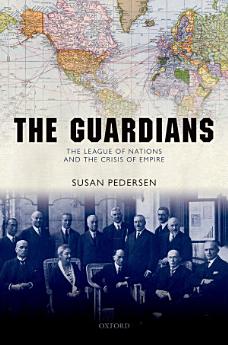
The Guardians: The League of Nations and the Crisis of Empire
Jul 2015 · OUP Oxford
Ebook
400
Pages
Tools
info
family_home
Eligible
info
About this ebook
The First World War threw the imperial order into crisis. New states emerged from the great European land empires, while Germany's African and Pacific colonies, and the Ottoman provinces in the Middle East fell into allied hands. Britain, France, Belgium, Japan, and the British dominions wanted to keep the new states, but Woodrow Wilson and the millions converted to the ideal of self-determination thought otherwise. At the Paris Peace conference of 1919, the allies agreed reluctantly to govern their new conquests according to international and humanitarian norms and under 'mandate' from the League of Nations. As The Guardians shows, this decision had enormous consequences. The allies sought to use the League to safeguard imperial authority, but that authority was undermined by the mechanisms for international oversight they had themselves created. Colonial nationalists and humanitarians exploited new rights of petition or opportunities for publicity to expose abuses or scandals; Germans resentful of the loss of their colonies and Italians eager to found a new empire arrived in Geneva to demand a repartition of the spoils. As imperial politicians wearied of continual scandals and crises - revolts in South West Africa, Syria, Samoa, and Palestine; famine in Rwanda; labour abuses in New Guinea; extortionate oil contracts in Iraq - they began to question whether independent states might be easier to deal with than territories subject to international scrutiny. Drawing on research in four continents and dozens of archives, and bringing to life a global network of nationalists, humanitarians, international bureaucrats, and imperial statesmen, The Guardians offers an entirely new interpretation of the importance of international organizations in the emergence of the modern world order.
The First World War threw the imperial order into crisis. New states emerged from the great European land empires, while Germany's African and Pacific colonies, and the Ottoman provinces in the Middle East fell into allied hands. Britain, France, Belgium, Japan, and the British dominions wanted t...
About the author
Susan Pedersen was born to Canadian missionary parents and spent her childhood in Japan and Minnesota. Rescued by Harvard at the age of 18, she spent the next 26 years there as a student, faculty member, and sometime Dean for Undergraduate Education. A historian of Britain and Europe with wide interests and an a penchant for far-flung research, she has written on subjects ranging from the history of women's movements, to the origins of welfare states, to British rule in Kenya, Hong Kong, and Palestine. Since 2003, she has been on the faculty at Columbia University, where she teaches courses on British and international history, and on 'great books' from Plato to Nietzsche. She lives in Manhattan with her husband and two children.
Susan Pedersen was born to Canadian missionary parents and spent her childhood in Japan and Minnesota. Rescued by Harvard at the age of 18, she spent the next 26 years there as a student, faculty member, and sometime Dean for Undergraduate Education. A historian of Britain and Europe with wide in...
Rate this ebook
Tell us what you think.
Reading information
Smartphones and tablets
Install the Google Play Books app for Android and iPad/iPhone. It syncs automatically with your account and allows you to read online or offline wherever you are.
Laptops and computers
You can listen to audiobooks purchased on Google Play using your computer's web browser.
eReaders and other devices
To read on e-ink devices like Kobo eReaders, you'll need to download a file and transfer it to your device. Follow the detailed Help Center instructions to transfer the files to supported eReaders.