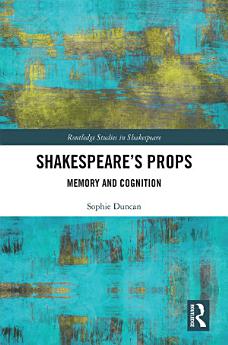
Shakespeare’s Props: Memory and Cognition
Jan 2019 · Routledge
Ebook
294
Pages
family_home
Eligible
info
About this ebook
Cognitive approaches to drama have enriched our understanding of Early Modern playtexts, acting and spectatorship. This monograph is the first full-length study of Shakespeare’s props and their cognitive impact. Shakespeare’s most iconic props have become transhistorical, transnational metonyms for their plays: a strawberry-spotted handkerchief instantly recalls Othello; a skull Hamlet. One reason for stage properties’ neglect by cognitive theorists may be the longstanding tendency to conceptualise props as detachable body parts: instead, this monograph argues for props as detachable parts of the mind. Through props, Shakespeare’s characters offload, reveal and intervene in each other’s cognition, illuminating and extending their affect. Shakespeare’s props are neither static icons nor substitutes for the body, but volatile, malleable, and dangerously exposed extensions of his characters’ minds. Recognising them as such offers new readings of the plays, from the way memory becomes a weapon in Hamlet’s Elsinore, to the pleasures and perils of Early Modern gift culture in Othello. The monograph illuminates Shakespeare’s exploration of extended cognition, recollection and remembrance at a time when the growth of printing was forcing Renaissance culture to rethink the relationship between memory and the object. Readings in Shakespearean stage history reveal how props both carry audience affect and reveal cultural priorities: some accrue cultural memories, while others decay and are forgotten as detritus of the stage.
Cognitive approaches to drama have enriched our understanding of Early Modern playtexts, acting and spectatorship. This monograph is the first full-length study of Shakespeare’s props and their cognitive impact. Shakespeare’s most iconic props have become transhistorical, transnational metonyms f...
Discover more
About the author
Dr. Sophie Duncan is a Fellow in English at Christ Church College, University of Oxford.
Dr. Sophie Duncan is a Fellow in English at Christ Church College, University of Oxford.
Rate this ebook
Tell us what you think.
Reading information
Smartphones and tablets
Install the Google Play Books app for Android and iPad/iPhone. It syncs automatically with your account and allows you to read online or offline wherever you are.
Laptops and computers
You can listen to audiobooks purchased on Google Play using your computer's web browser.
eReaders and other devices
To read on e-ink devices like Kobo eReaders, you'll need to download a file and transfer it to your device. Follow the detailed Help Center instructions to transfer the files to supported eReaders.