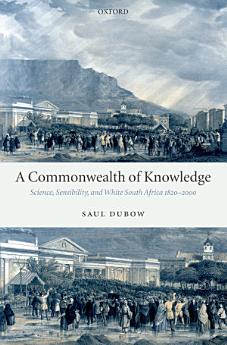
A Commonwealth of Knowledge: Science, Sensibility, and White South Africa 1820-2000
Oct 2006 · OUP Oxford
Ebook
308
Pages
family_home
Eligible
info
About this ebook
A Commonwealth of Knowledge addresses the relationship between social and scientific thought, colonial identity, and political power in nineteenth- and twentieth-century South Africa. It hinges on the tension between colonial knowledge, conceived of as a universal, modernizing force, and its realization in the context of a society divided along complex ethnic and racial fault-lines. By means of detailed analysis of colonial cultures, literary and scientific institutions, and expert historical thinking about South Africa and its peoples, it demonstrates the ways in which the cultivation of knowledge has served to support white political ascendancy and claims to nationhood. In a sustained commentary on modern South African historiography, the significance of `broad' South Africanism - a political tradition designed to transcend differences between white English- and Afrikaans-speakers - is emphasized. A Commonwealth of Knowledge also engages with wider comparative debates. These include the nature of imperial and colonial knowledge systems; the role of intellectual ideas and concepts in constituting ethnic, racial, and regional identities; the dissemination of ideas between imperial metropole and colonial periphery; the emergence of amateur and professional intellectual communities; and the encounter between imperial and indigenous or local knowledge systems. The book has broad scope. It opens with a discussion of civic institutions (eg. museums, libraries, botanical gardens and scientific societies), and assesses their role in creating a distinctive sense of Cape colonial identity; the book goes on to discuss the ways in which scientific and other forms of knowledge contributed to the development of a capacious South Africanist patriotism compatible with continued membership of the British Commonwealth; it concludes with reflections on the techno-nationalism of the apartheid state and situates contemporary concerns like the `African Renaissance', and responses to HIV/AIDS, in broad historical context.
A Commonwealth of Knowledge addresses the relationship between social and scientific thought, colonial identity, and political power in nineteenth- and twentieth-century South Africa. It hinges on the tension between colonial knowledge, conceived of as a universal, modernizing force, and its real...
About the author
Saul Dubow is professor of history at the University of Sussex. Born in South Africa and educated at the Universities of Cape Town and Oxford, he has written key books on the history of racial segregation and apartheid; the history of scientific racism in South Africa, and the history of colonial science. He has edited several collections and is considered to be a leading authority on race, nationalism and identity in modern South Africa.
Saul Dubow is professor of history at the University of Sussex. Born in South Africa and educated at the Universities of Cape Town and Oxford, he has written key books on the history of racial segregation and apartheid; the history of scientific racism in South Africa, and the history of colonial...
Rate this ebook
Tell us what you think.
Reading information
Smartphones and tablets
Install the Google Play Books app for Android and iPad/iPhone. It syncs automatically with your account and allows you to read online or offline wherever you are.
Laptops and computers
You can listen to audiobooks purchased on Google Play using your computer's web browser.
eReaders and other devices
To read on e-ink devices like Kobo eReaders, you'll need to download a file and transfer it to your device. Follow the detailed Help Center instructions to transfer the files to supported eReaders.